Key takeaways
- You fill in the recipient block, check your add-ons and write each fee beside it; the clerk adds postage and postmarks your receipt.
- A 1 oz stamped Certified Mail letter costs $6.37 as of July 12, 2026; an electronic return receipt brings it to $9.28.
- Use Form 3817 for proof of mailing only, Form 3800 for Certified Mail, and Form 3811 when you want the signature card mailed back.
You're at the post office counter, the clerk slides a green-and-white slip across, and the line is building behind you. That slip is PS Form 3800, the Certified Mail receipt. Fill it out correctly and you leave with a postmarked receipt showing USPS accepted a mailpiece addressed there, on that date. Fill it out wrong and it comes back across the counter.
Here's the whole job in four moves:
- Write the recipient's name and delivery address in the boxed section at the bottom of the form — exactly as they appear on the envelope.
- Check only the extra services you're paying for, and write each fee beside its box. The next section prices every one.
- Attach the form to the front of the envelope — above the delivery address, to the right of your return address, barcode visible.
- Hand it to the clerk. They ring up the postage and fees, postmark the form, and tear off your copy. That postmarked receipt is your proof of mailing. Keep it. If the time matters, ask the clerk to write it on your receipt. Bought the electronic return receipt? After you mail it, enter the article number from that receipt and your email address on USPS Tracking.
Not standing at a counter? If you came here to print a certified label online — or to skip the form entirely — jump ahead to printing and sending online.
Only need proof that you mailed something, with no tracking or signature? A Certificate of Mailing (PS Form 3817, $2.45 plus postage) is the cheaper form.
Below is how to fill out a certified mail receipt field by field, with every fee current as of the July 12, 2026 rate change. If you're reading a guide with older numbers, that's why they differ.
What's on Form 3800: every field, mapped#
Certified Mail is an add-on service, not a mail class — the form is how the add-on gets attached, priced, and postmarked. Six things live on it. Three are yours; three belong to USPS.
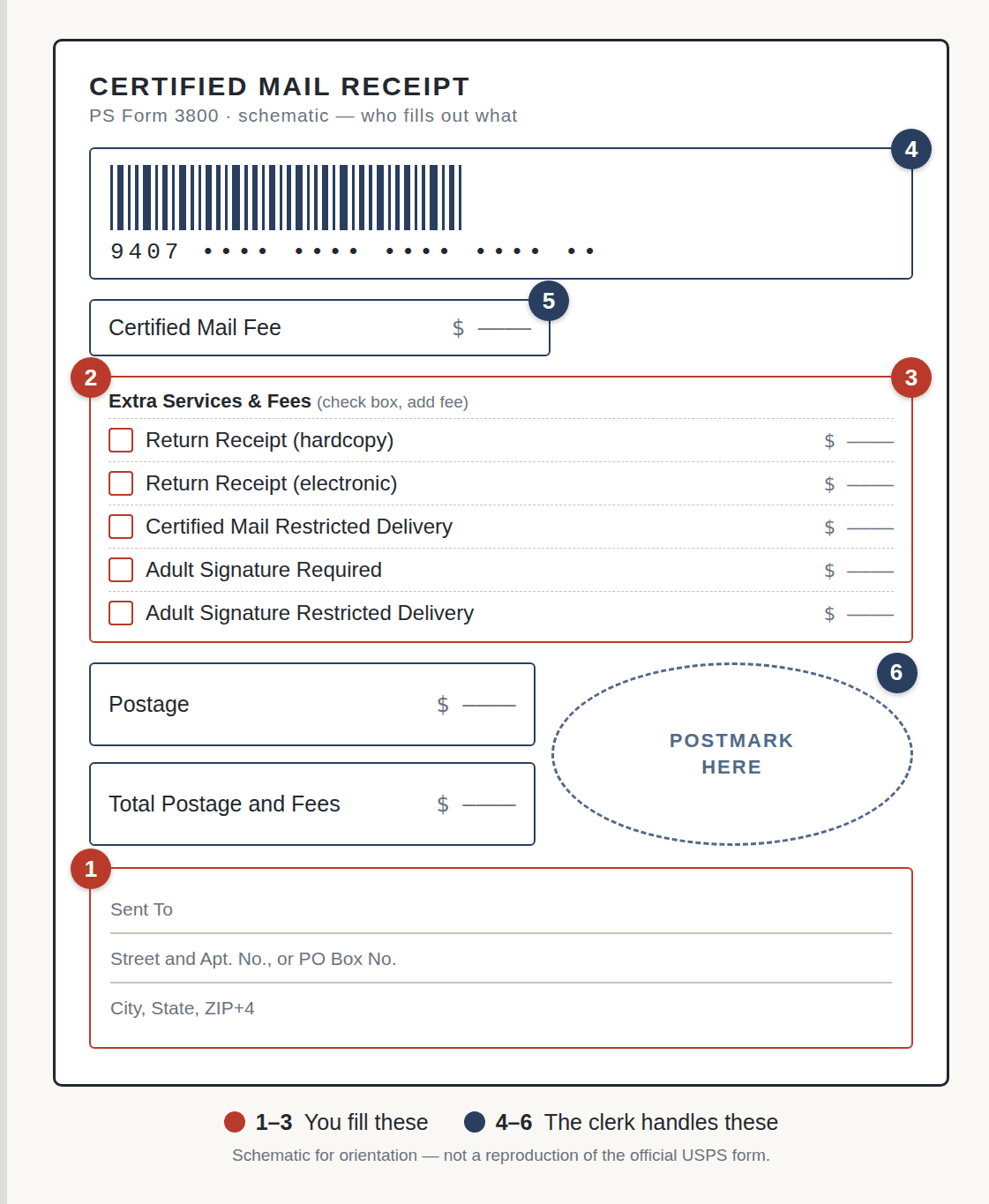
- Yours — the recipient block. The boxed lines at the bottom: Sent To, Street and Apt. No., or PO Box No., City, State, ZIP+4. Copy them from the envelope exactly. If the form and the envelope disagree, you've built a dispute into your own proof.
- Yours — the extra-services checkboxes. The menu in the middle. Check only what you're buying; the next section prices each box.
- Yours — the fee beside each box you check. The form says "check box, add fee as appropriate," so write each fee on its line.
- The clerk's — the barcode and article number. Preprinted, and printed twice: once on the strip that travels on your envelope, once on the stub you keep. That number is your tracking number; track it with USPS (opens in new tab) once the letter is moving.
- The clerk's — the fee and postage boxes. Certified Mail Fee, Postage, Total Postage and Fees — written or meter-printed at acceptance.
- The clerk's — the postmark circle. Postmark Here. In the form's own words: "to ensure that your Certified Mail receipt is accepted as legal proof of mailing, it should bear a USPS postmark" — so present the piece at a Post Office and the clerk stamps your copy. Skip the counter and the whole receipt is yours: attach the barcoded label, put enough postage on the envelope to cover the mail class and every fee, date your receipt, and mail the letter. You still get tracking — but an unpostmarked receipt may not be accepted as legal proof of mailing.
The checkboxes: what each one costs and what it buys you#
The middle of Form 3800 is a menu labeled "Extra Services & Fees." This is where a $6.37 letter becomes a $19.82 letter — sometimes because you needed it to, sometimes because a checkbox sounded important. Here's what each one actually buys.
- The form itself — $5.55 plus postage. A postmarked mailing receipt and an article number you can track, and USPS keeps a delivery record with the recipient's signature. Skip it when you only need proof that you sent it: use a Certificate of Mailing (Form 3817) instead.
- Return Receipt (hardcopy) — $4.65. The green card (Form 3811) travels with the letter and comes back to you by mail with the signature and delivery date. Skip it when a signature on screen is enough: the electronic version is $1.74 cheaper, and you don't wait for a card to come back through the mail.
- Return Receipt (electronic) — $2.91. A proof-of-delivery letter with the signature, emailed once you ask for it: enter the article number on USPS Tracking (opens in new tab) and give your email address, and USPS sends it after delivery. Skip it when your instructions, contract or counsel require the mailed Form 3811. Pick one return receipt, not both.
- Certified Mail Restricted Delivery — $14.35, which replaces the $5.55. Don't add the two: Certified Mail with Restricted Delivery is $14.35 in fees, not $19.90 ($5.55 + $14.35). Delivery is limited to the named addressee or their authorized agent, and the addressee must be an individual named on the envelope, not a company or office. Skip it when nothing requires delivery to that one person.
Fees effective July 12, 2026, per USPS Notice 123 (opens in new tab).
What about the last two checkboxes? The form also lists Adult Signature Required and Adult Signature Restricted Delivery ($14.35 each, in place of the $5.55). Leave them alone: they're commercial options for Priority Mail shippers, and the form itself marks both "not available at retail." At a counter with a First-Class letter, they're not on the menu.
Here's what the counter actually costs with a 1 oz letter and a stamp ($0.82 postage):
You're buying | Total (1 oz, stamped) |
|---|---|
Certified, no return receipt | $6.37 ($0.82 + $5.55) |
Certified + electronic return receipt | $9.28 ($0.82 + $5.55 + $2.91) |
Certified + green card | $11.02 ($0.82 + $5.55 + $4.65) |
Certified Restricted Delivery + green card | $19.82 ($0.82 + $14.35 + $4.65) |
Choosing between the green card and the emailed receipt deserves more than a table row — our electronic Certified Mail guide explains electronic records and their legal caveats. And if you want every combination totaled, what Certified Mail costs runs the full math.
Where the forms go on the envelope#
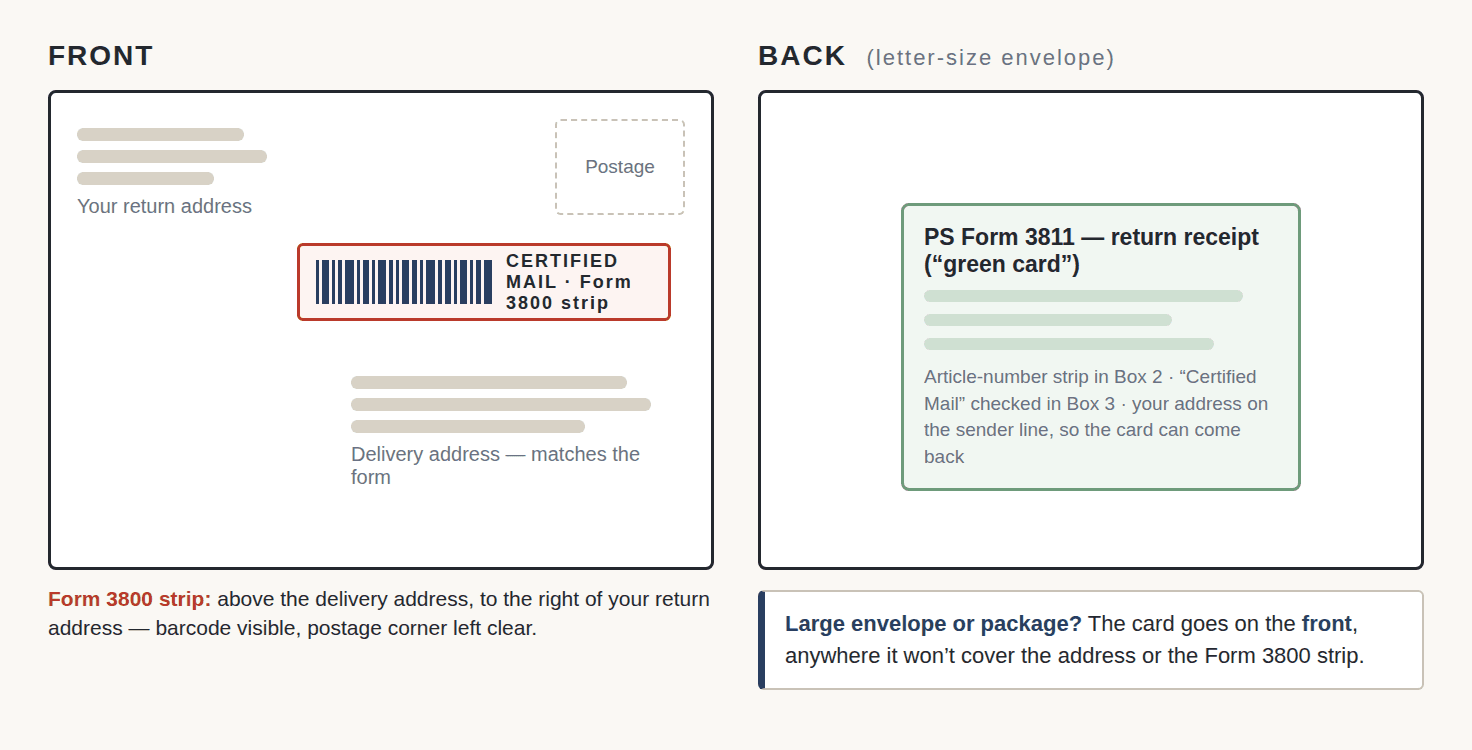
Form 3800 goes on the address side — above the delivery address and to the right of your return address, with the barcode fully visible and the top-right corner left clear for postage. The perforated stub stays attached until the clerk stamps and returns it.
If you added the green card, Form 3811 has four things to complete before it's attached:
- Box 1 (front): the recipient's name and address — same as the envelope, same as the 3800.
- Box 2 (front): the article number. Peel the tracking strip from the top of Form 3800 and stick it here (or copy the number by hand).
- Box 3 (front): check Certified Mail, or Certified Mail Restricted Delivery if you bought it.
- The sender block (back): your own name and address — this is the address the card gets mailed back to. A green card with an empty sender block is a signature USPS can't return to you.
Then attach the card to the back of a letter-size envelope. On a large envelope or package, it goes on the front, anywhere it won't cover the address or the 3800.
Whichever return receipt you buy, put your own name and address on the envelope. For the green card, also write "Return Receipt Requested" on the address side, near the Certified Mail label; the electronic receipt needs no endorsement.
The clerk handles the rest at acceptance: pricing the boxes you checked, stamping the postmark circle, and handing back your stub.
Which form do you actually need? (3817 vs 3800 vs 3811)#
"Certified mail forms" is really three different forms answering three different questions. Match the form to the proof you'll need later — the differences are cheap to get right now and expensive to discover in a dispute.
The proof you need | Form and counter cost (1 oz letter) | What you can show later |
|---|---|---|
I sent it, on this date | $3.27: Certificate of Mailing (Form 3817) | A postmarked certificate — no tracking, and USPS keeps no copy |
It was delivered (or delivery was attempted) | $6.37: Certified Mail (Form 3800) | Postmarked receipt and tracking history. USPS keeps the signature; a return receipt gets you a copy |
Who signed, and when | $9.28 with the emailed receipt: Form 3800 + Return Receipt (3811 or electronic) | The signature and delivery date, in your hands |
Delivery restricted to the addressee (or their authorized agent) | $15.17: Form 3800 + Restricted Delivery | Receipt and tracking; USPS delivers only to the named person or their authorized agent. Add a return receipt for the signature |
Two boundaries worth knowing. Certified Mail rides only on First-Class Mail or Priority Mail — it is not available with Priority Mail Express. And an ordinary postmark on an ordinary envelope is not proof of mailing — if the date matters, it needs a form. (If a court filing is what brought you here, note that a Certificate of Service is a legal document, not a USPS product — and some notices require certified mail specifically.)
Can you print Form 3800 or send Certified Mail online?#
Not the green form itself. You can download a specimen of Form 3800 from USPS (opens in new tab), but printing it doesn't work — the barcode and article number are preprinted and unique to each physical form, so a home-printed copy has no live tracking number. The forms are free: pick them up at any post office counter, or order packs from the USPS Postal Store.
What you can do is skip the form. Online Certified Mail providers generate the certified barcode electronically — a printed label or cover sheet whose barcode is the certified article number. No counter and no Form 3800 — though if you print a certified shipping label yourself, USPS also requires the small green Label 3800-N on the envelope, above the delivery address. When a statute, a contract, or your attorney requires Certified Mail, this is the same service with the paperwork moved online: electronic certified mail explains the mechanics and legal caveats. Certified Mail is not currently available through Postmarkr. For routine letters, you can send a letter online: upload a PDF, add recipients, and see the full price before checkout.
Keep the receipt: what it proves later#
The postmarked stub is the smallest piece of Certified Mail and the one you'll need most later. Here's what your $6.37 bought, and for how long:
- The postmarked receipt is your proof of mailing — USPS accepted this piece, addressed this way, on this date. It's the one artifact that exists even if the recipient never signs.
- The article number on the stub unlocks the rest. You need it to request the electronic return receipt; without it, you can't get one. If a green card you paid for never comes back, take the stub to any Post Office within 90 days and fill out Form 3811-A for the delivery information.
- USPS keeps the delivery record, including the signature — but the reliable way to get a copy in your hands is a return receipt purchased at mailing, not a records request afterward.
- Tracking history for Certified Mail stays available for 2 years. Screenshot or save the delivery confirmation before it ages out.
- If nobody's home, USPS leaves a notice and holds the piece 15 days; on the 16th day it starts back to you. A returned, unclaimed certified letter is itself evidence of the delivery attempt.
Staple the stub to your copy of what you mailed, note the tracking number, and file both. When the question is "did you actually send it?" — months later, in writing, from someone's lawyer — that stapled pair is your best answer: the stub proves USPS accepted your letter that day, and your copy is your record of what was inside.
Source and verification note#
Fees on this page are USPS's prices effective July 12, 2026, from USPS Notice 123 (opens in new tab) (Price List), checked September 2026. Service rules — eligibility, Restricted Delivery, return receipts, endorsements and Certificate of Mailing records — are from DMM 503, Extra Services (opens in new tab). Form fields, placement and postmark wording are from the current PS Form 3800 (opens in new tab) and PS Form 3811; hold periods, tracking history and electronic return receipt steps are from USPS's FAQ pages.