Key takeaways
- For mail service, date the certificate for the day the papers went into the mail, not the day they arrive.
- Mail adds days to the other side's deadline: 3 in federal court and Texas, 5 in Florida, and 5 in California for in-state mail.
- Federal Rule 5 doesn't require Certified Mail for papers served after the complaint. First-class mail to the last known address is enough where your court allows mail service.
A certificate of service is the short signed statement, usually at the end of a filing, that tells the court what you sent to the other parties, who got it, how you sent it and on what date. It's how the judge knows everyone had a fair chance to see the paper before anything is decided on it. For the same reason, a judge generally won't consider a private letter from one side about a pending case; how to address a letter to a judge explains when you can write to one directly.
This guide is for people who serve papers without a docketing department behind them: solo attorneys, small-firm paralegals and business owners handling their own cases. It gives you wording to adapt for mail service, the date rules that trip people up, and the records worth keeping in case anyone says they never got it.
This is general information, not legal advice. Your court's rules, local rules and official forms decide what your certificate must say.
WRITE IT
What goes in a certificate of service#
Court forms are worded differently, but almost every certificate answers the same five questions:
- When you served it: the date service happened under your rule.
- What you served: the document's exact title, as it appears in the caption.
- How you served it: first-class mail, hand delivery, email, the court's e-filing system or another method your rule allows.
- Who you served, and where: each person's name and the mailing address, email address or e-filing account you used. If a party has a lawyer, you serve the lawyer, not the party.
- Who signed it: your signature, printed name and contact details.
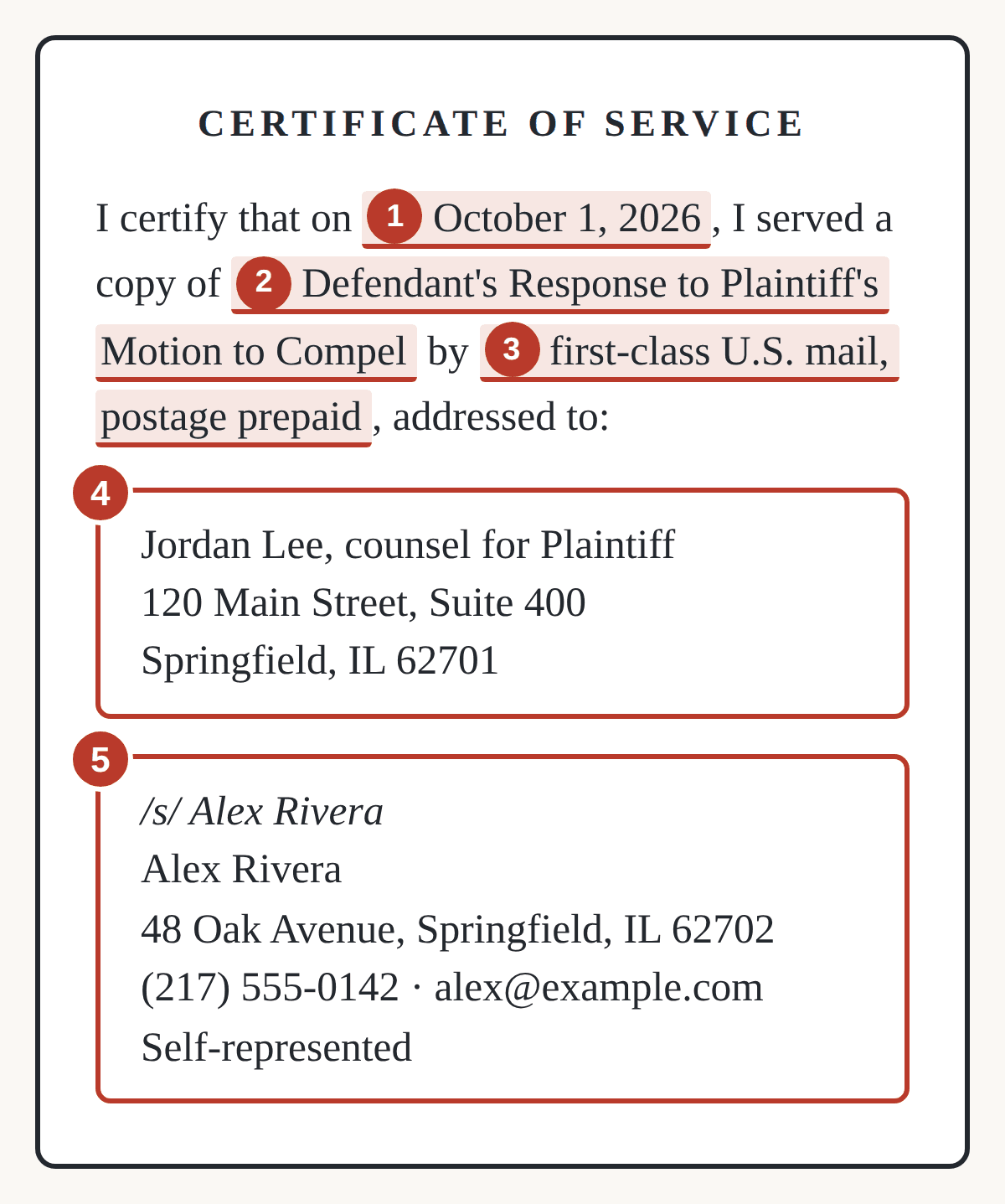
A certificate covers the papers exchanged once a case is under way: motions, responses, discovery and notices. The summons and complaint that start a lawsuit are served under a different rule (Rule 4 in federal court) and proven with a proof or affidavit of service, not a certificate.
Where it goes and when it's filed#
Most filers put the certificate on the last page of the document it covers, after the signature, so it's filed and served with the paper; Texas requires it on the filed document itself. If you file it separately, give it the same caption as the paper: the court, the party names and the case number.
In federal court, you don't need a certificate for anyone served through the court's electronic filing system. For anyone you serve another way, the certificate goes in with the paper or "within a reasonable time after service," under Federal Rule of Civil Procedure 5(d)(1)(B) (opens in new tab). Papers that aren't filed, such as most discovery, still get served, but you file a certificate for them only if a court order or local rule requires it.
In California, it's a proof of service
California calls the document a proof of service. On its optional form for service by first-class mail (opens in new tab), the person who mailed the papers signs: someone over 18 who isn't a party, lives or works in the county where the mailing happened, and states the date and place of mailing.
If you're representing yourself, someone else mails the papers and signs. Because the signer either deposits the envelope or places it in their own office's outgoing mail, a print-and-mail service doesn't fit this form.
Sample certificate of service wording for mail#
Use your court's official form when it has one; many court self-help centers publish fill-in versions. If yours doesn't, the samples below follow the elements federal and state forms share. Replace everything in brackets. Sending a cover letter with the papers? Start from our template for a cover letter to opposing counsel.
One recipient, served by first-class mail
CERTIFICATE OF SERVICE

I certify that on [Month Day, Year],
I served a copy of [exact document
title] by first-class U.S. mail,
postage prepaid, addressed to:

[Name], counsel for [Party]
[Street address]
[City, State ZIP]
[Repeat for each person served]

/s/ [Your Name]
[Your Name]
[Street address]
[City, State ZIP]
[Phone] | [Email]
[Role, e.g., Self-represented]
E-filing for some recipients, mail for others
CERTIFICATE OF SERVICE

I certify that on [Month Day, Year],
I filed [exact document title] with
the Clerk of Court using the [court
e-filing system], which will send
notice to all registered users.

I further certify that on the same
date I served a copy by first-class
U.S. mail, postage prepaid, on these
participants, who are not registered
for electronic service:

[Name]
[Street address]
[City, State ZIP]
[Repeat for each person served]

/s/ [Your Name]
[Signature block as above]
When a print-and-mail service sends the papers for you, "caused to be mailed" describes what happened more accurately than "mailed." Federal pro se forms such as the District of Minnesota's certificate of service by mail (opens in new tab) use that wording. The date still has to be the day the papers entered the mail, which the next section covers.
Four details keep the certificate accurate:
- Use the exact title: "Defendant's Response to Plaintiff's Motion to Compel," not "my response."
- List the address you actually used, taken from the docket or the latest notice of appearance, not an old letterhead.
- Describe the method the way your rule does. "First-class U.S. mail, postage prepaid" tells the court exactly what happened.
- Sign the way your court accepts. Registered e-filers generally use "/s/ Name"; paper filers sign by hand.
Some states write the wording for you. Florida's Rule 2.516(f) (opens in new tab) supplies a one-sentence certificate covering the date, each name and service address, and the method. Texas Rule 21a(e) (opens in new tab) makes a signed certificate prima facie evidence that service happened, which the other side can rebut by proving the papers never arrived.
DATE IT
Which date goes on the certificate#
The date of service is the day service happened under your rule, not the day you drafted the paper or the day it arrives. For mail, federal Rule 5(b)(2)(C) (opens in new tab) says service by "mailing it to the person's last known address" is "complete upon mailing." The certificate carries the date the envelope went into the mail.
| How you served | Date on the certificate |
|---|---|
| First-class mail | The day it goes into the mail |
| Court e-filing system | The day you file (no certificate needed) |
| Email the person agreed to in writing | The day you send it (not effective if you learn it didn't arrive) |
| Hand delivery | The day you hand it over or leave it |
| Left with the clerk | The day you leave it (only if there's no known address) |
Source: Federal Rules of Civil Procedure 5(b)(2) and 5(d)(1)(B). Checked October 2, 2026. | |
Using a print-and-mail service?
A print-and-mail service prints your papers first and hands them to USPS afterward, so the day you order isn't the day they enter the mail. Date the certificate for the day the papers entered the mail, and ask the service what record of that date it gives you. If it can't confirm the date, don't certify a date you can't back up: mail the papers yourself at a Post Office counter and ask for a Certificate of Mailing.
Postmarkr works the same way. Each letter's page keeps a downloadable PDF of what went to print, the address on the order and a status timeline. The printing and mailing stages it shows are estimated from elapsed time, not a USPS-confirmed mailing date, and Postmarkr doesn't offer Certified Mail or Certificates of Mailing. That makes it a useful record of what you sent, but not proof of the date you mailed it. When a matter has dozens of parties, such as a bankruptcy case, legal noticing services are built for that volume.
How many extra days mail adds#
The extra days work in both directions. When the other side mails you a motion, your response period gets the same extension. Federal Rule 6(d) (opens in new tab) adds 3 days after the normal period would end when service is by mail, by leaving papers with the clerk, or by another non-electronic method the person agreed to in writing. The extra days apply only to deadlines that run from service, not from filing or from the entry of an order. Since 2016, electronic service gets no extra days.
Here's how the count works under the federal rules when the other side mails you a motion and you have 14 days to respond:
- Wednesday, October 7, 2026: the motion goes into the mail, and service is complete.
- Wednesday, October 21: day 14, the normal deadline. Start counting the day after service, and count every day, including weekends and legal holidays.
- Saturday, October 24: add 3 days for mail service.
- Monday, October 26: your response is due, because a deadline that lands on a weekend or legal holiday moves to the next day that isn't one.
| Court | Extra days for mail | Rule |
|---|---|---|
| Federal court | 3 days | FRCP 6(d) |
| Texas | 3 days | TRCP 21a(c) |
| Florida | 5 days, when served only by mail | Fla. Rule 2.514(b) |
| California | 5 calendar days in California; 10 if either the mailing or the address is elsewhere in the U.S. | Code Civ. Proc. § 1013(a) |
Source: Checked against the current rule text on October 2, 2026. | ||
Read the rules themselves: Texas Rule 21a (opens in new tab), Florida Rule 2.514 (opens in new tab) and California Code of Civil Procedure section 1013 (opens in new tab). Texas also treats mail service as complete when the papers are deposited in the mail, postpaid and properly addressed.
PROVE IT
Do you need Certified Mail to serve by mail?#
Usually not, for papers served after the case begins. Federal Rule 5 asks only for "mailing it to the person's last known address," and Texas and Florida also allow ordinary U.S. mail where mail service is permitted. A first-class letter meets the rule.
Before you mail anything, check that your court allows it. In Texas and Florida, documents filed electronically generally must be served electronically on anyone whose email is on file, so mail mostly reaches people outside the e-service system, such as some self-represented parties.
Certified Mail becomes necessary when something specific requires it: a statute, a court order, a contract's notice clause, or a state rule for serving the summons itself by mail. Some filers choose it anyway when they expect a fight over receipt, because it adds a mailing receipt and USPS tracking of delivery or attempted delivery (how Certified Mail works). To get the recipient's signature, buy Return Receipt at the same time. Our Certified Mail cost guide has the full fee breakdown; the fees apply to every name on your service list.
| Record | What it shows | USPS fee |
|---|---|---|
| Certificate of service | Your signed statement to the court about what you served, on whom, how and when. No delivery record. | None |
| Certificate of Mailing (PS 3817) | A Post Office receipt showing an item was mailed to an address on a date. No delivery record; USPS keeps no copy. | $2.45 each + postage |
| Certified Mail | A mailing receipt plus tracking of delivery or attempted delivery. A signature copy needs Return Receipt. | $5.55 each + postage |
Source: USPS Notice 123 prices effective July 12, 2026; service rules from USPS Domestic Mail Manual 503. | ||
A Certificate of Mailing gives you independent proof of the mailing date for an ordinary letter. You present it with the mail at the counter, at the time of mailing (USPS Domestic Mail Manual 503 (opens in new tab)). Serving three or more people at once? You can list them on a firm sheet, PS Form 3665 (Certificate of Mailing — Firm), instead of filling out one form per letter. A Certificate of Mailing backs up your certificate of service; it doesn't replace it. For a side-by-side of the USPS options, see Certified Mail alternatives.
What to keep in your service file#
The certificate is your statement. The file is what backs it up if someone says they never got the papers, or got a different version. For each round of service, keep:
- The exact PDF you served, with exhibits, saved as the final version.
- The certificate as filed, plus the court's filing receipt.
- Where each address came from: a dated docket printout or the notice of appearance.
- Your proof of mailing: a Certificate of Mailing or a Certified Mail receipt.
- Downloaded tracking history, if the piece had tracking. USPS keeps Certified Mail tracking for 2 years and basic USPS Tracking for 120 days. A plain First-Class letter has no USPS Tracking unless you add an extra service such as Certified Mail.
- Anything that comes back, unopened, in its envelope.
CHECK IT
Mistakes to check before you sign#
- The wrong date. For mail, it's the day the papers went into the mail, not the day you signed, filed or expect delivery.
- Serving the party instead of the lawyer. Under federal Rule 5(b)(1) (opens in new tab), if a party has an attorney, you serve the attorney unless the court orders otherwise.
- A missing name. Check the docket for every party and attorney of record. Self-represented parties often aren't on e-filing and need paper service.
- A stale address. Use the most recent address on record, and check for a change-of-address notice before you mail.
- Forgetting the mail days. Add them when you calculate the other side's deadline, and your own when they serve you by mail.
- Naming the wrong USPS service. Don't write "certified mail" if you sent First-Class, and don't call a Certificate of Mailing proof of delivery.
- Letting an address checker override the record. Address verification can fix a ZIP Code or flag an undeliverable address, but the service address comes from the record. Don't let a suggested correction quietly change it.
What to do if the mail comes back#
Federal Rule 5 treats mail service as complete when you mail it, but a returned envelope tells you the other side may not have the papers. In Texas, the recipient can rebut your certificate by showing the papers never arrived. Don't ignore a return:
- Keep the envelope unopened, with its USPS markings, in the service file.
- Check the docket and your records for a newer address.
- Consider serving again at the corrected address or by another permitted method, and ask the clerk whether your court expects an amended or supplemental certificate.
- If a deadline is close or you can't find the person, get legal advice before the deadline passes.
Refused and unclaimed Certified Mail raises its own questions; our guide to refused and unclaimed Certified Mail explains each USPS marking.