
You pay the $5.55 Certified Mail fee for a letter that matters — a lease notice, a demand letter, an IRS reply due Friday — and walk out feeling like the Postal Service is now guarding your envelope.
It does not. Your letter joins the ordinary mail.
No courier, no locked pouch. What you bought is not a different trip. It is a record of the trip: proof USPS accepted the letter, a record of delivery or attempted delivery, and — if someone accepts it — a signature USPS retains. That is how certified mail works: a witness, not an escort.
Here is the whole system, stage by stage: what happens to the letter, what gets written down, and what you can prove at each point.
The life of a certified letter#
It starts with the green form, PS Form 3800. The barcoded label sticks to your envelope; the stub comes back to you. If USPS postmarks that receipt, it records that USPS accepted a mailpiece bearing that address on that date. It does not establish what was inside. Keep it anyway; it is your first piece of evidence. For the boxes and placement details, use the field-by-field Form 3800 guide.
The barcode is scanned at acceptance, and the log has started.
Then comes the part many senders misunderstand. Nothing special happens to the ride. USPS's own mailing standards say certified pieces are "dispatched and handled in transit as ordinary mail" (USPS Domestic Mail Manual, Certified Mail standards). Your letter moves at the speed of the class you bought, First-Class or Priority, and the certified service itself adds no insurance along the way. While the envelope rides like any other, the record behind it grows as USPS logs events. That asymmetry is the point.
At the address, certified stops being ordinary. At most addresses, a certified letter is not simply dropped into the mailbox: USPS needs a signature record before the piece is handed over. Usually that means someone signs on the spot; USPS procedures also recognize certain electronic signatures already on file (USPS Domestic Mail Manual, delivery conditions).
Notice the word someone. The named addressee does not necessarily have to sign. Without Restricted Delivery, USPS may deliver the letter to any person who normally receives mail at that address: a spouse, a receptionist, an apartment building's front desk. The signature records that USPS delivered the letter there and someone accepted it. Whether that distinction matters depends on the rule governing your notice. Restricted Delivery narrows whom USPS may deliver to — the addressee or their authorized agent — though it does not by itself decide what a court will accept.
What happens at that door decides which record you end up with. There are three ways it goes.
It is accepted. USPS logs the delivery and files the signature. That record exists whether or not you ever ask for it. If you want your own copy of who signed and when, that is Return Receipt, purchased at the time of mailing, not after.
Nobody is available. The carrier leaves a notice, PS Form 3849, and the letter goes back to the local Post Office to wait. It waits 15 days for a pickup or a redelivery request, and then it starts the trip back to you (USPS Certified Mail FAQ).
You will not get a signature on this branch, but you are not left empty-handed. USPS records the attempted delivery and the eventual outcome, though individual tracking events may not always appear immediately. What an unclaimed envelope means for your particular notice is its own question: see certified mail returned unclaimed.
It is refused. The addressee is allowed to turn a certified letter away when it is offered (USPS Domestic Mail Manual, recipient options). A refusal does not enter the unclaimed-mail holding clock: USPS marks the refusal and returns the piece to the sender. The record shows that USPS offered the letter for delivery and the addressee refused it. What refusal means for a legal notice varies. See refused and unclaimed certified mail.
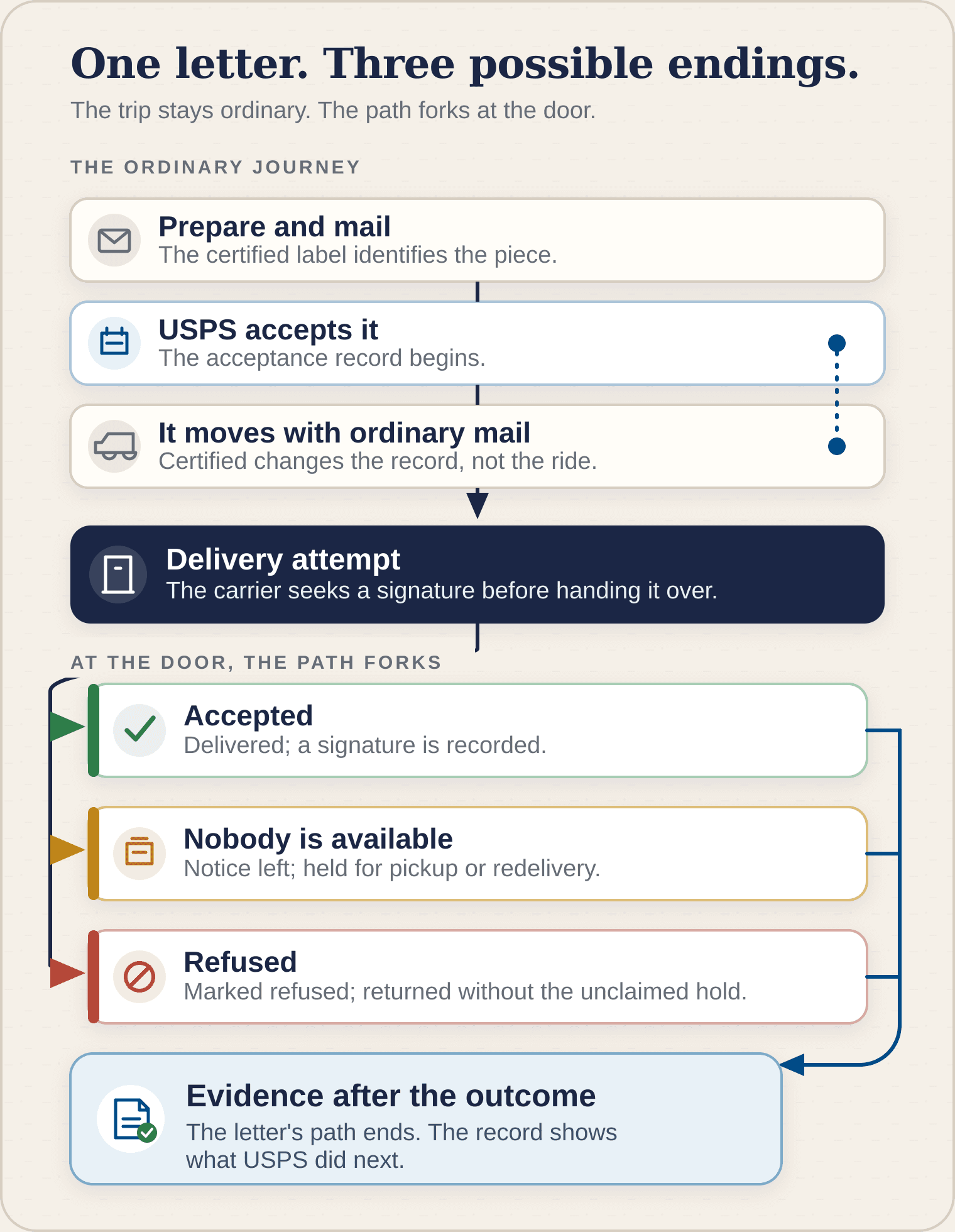
The same journey, as a reference:
Moment | What you hold | What USPS records | What happens to the letter |
|---|---|---|---|
Mailing | Postmarked Form 3800 receipt | Acceptance scan | Enters the mailstream |
In transit | Nothing new | Scan events as they occur | Rides as ordinary mail at the class's speed |
Delivery attempt | Tracking updates | The attempt | Carrier seeks a signature before handing it over |
Accepted | Return Receipt copy, if purchased at mailing | Delivery event plus the signature on file | Delivered |
Unclaimed | Saved tracking history; returned envelope when received | Notice left; return after 15 days | Waits at the Post Office, then returns to you |
Refused | The returned envelope, marked | The refusal and the return | Returns without the unclaimed-mail holding period |
Where the proof lives#
A record now exists, and most of it is not in your hands. Certified Mail splits its evidence between you and the Postal Service, and it is easy to lose track of that split.
Evidence to save
- The postmarked Form 3800 receipt
- A saved or downloaded copy of the tracking history
- The electronic Return Receipt PDF or green card, if purchased
- The returned envelope with every USPS marking, if the letter comes back
USPS keeps the acceptance scan, the delivery or attempt record, and the signature. Certified Mail tracking history stays retrievable for two years. A copy of that signature reaches you only if you purchased Return Receipt at the time of mailing.
So treat recordkeeping as part of the service. Save the receipt for as long as the matter could resurface. Download the electronic Return Receipt PDF as soon as it arrives. Export or screenshot the tracking history rather than assuming you can look it up later. If the envelope comes back, keep it, markings and all.
Go deeper: what courts accept as proof · what to save and for how long · is certified mail enough for legal notice?.
What Certified Mail proves — and where it stops#
The record is real evidence, but it is specific evidence. Be precise about what each piece establishes: acceptance of a mailpiece bearing that address on that date, delivery or attempted delivery, and a signature when someone accepts the piece.
Where it stops:
- No speed boost. Transit is ordinary mail.
- No added insurance. Priority Mail's included insurance belongs to the class, not to the certified service.
- Contents are not independently verified. The record covers the piece, not what was inside it.
- The named addressee may not be the signer. Without Restricted Delivery, acceptance by someone who normally receives mail at that address completes delivery.
- Delivery is not guaranteed. A letter can wait out its 15 days unclaimed or be refused, and the record will show exactly that.
Certified Mail documents the envelope's journey. It does not document what was inside the envelope.
If your rule names Certified Mail, use Certified Mail — and see when certified mail is required if you are not sure it applies at all.
Return Receipt and Restricted Delivery#
Return Receipt is what turns "delivered" into "here is the signature proof." Electronic Return Receipt (ERR) delivers your copy as a PDF with the delivery details and signature information. The green card (PS Form 3811) is the physical postcard mailed back to you with the signature on it — slower, and it can be lost in the return mail, but some workflows still require it. ERR is faster to receive, cheaper, and easier to store. Choose the format your rule or workflow requires; for the full comparison, including the legal-acceptance caveats, see electronic return receipt vs the green card. If you are using either for litigation, confirm with counsel. Restricted Delivery answers a different question: not "was it delivered" but "who was allowed to take it." It controls the hand the letter lands in; whether that satisfies your rule is the rule's call.
Choose the record you need#
If you need | Choose | What it adds |
|---|---|---|
USPS acceptance plus a recorded delivery outcome | Certified Mail | The mailing receipt and USPS delivery or attempt record |
Your own copy of the signature and delivery details | Add Return Receipt at mailing | An electronic PDF or returned green card |
Acceptance limited to the addressee or authorized agent | Add Restricted Delivery | A narrower delivery instruction |
Your governing rule decides whether any of these records is enough. No USPS add-on can answer that question for you.
The quick answers: cost, timing, tracking#
Cost. Your total is postage plus the certified fee plus any add-ons you choose. The fees, current as of the July 12, 2026 rate change:
Item | Fee | What it buys |
|---|---|---|
Certified Mail | $5.55 | Mailing receipt, tracking, and the delivery or attempt record |
Return Receipt, electronic | $2.91 | A PDF copy of the signature and delivery details |
Return Receipt, green card | $4.65 | The signed card mailed back to you |
Certified Mail Restricted Delivery | $14.35 | Acceptance limited to the addressee or authorized agent; a combined fee that replaces the base certified fee, not added to it |
First-Class letter postage, 1 oz stamped | $0.82 | The ride itself |
First-Class letter postage, 1 oz metered | $0.78 | The ride, metered |
For worked totals and the full formula, see certified mail cost.
Timing. Certified Mail arrives when its class arrives: First-Class letters typically run 1–5 business days, Priority Mail 2–3, and neither window is a guarantee. The certified add-on neither speeds nor slows the trip.
Tracking. Your tracking number is printed under the barcode on the Form 3800 receipt. Track at USPS.com or in the USPS Mobile app. The statuses you will see most:
- Accepted / USPS in possession of item — USPS has it
- In Transit / Arrived at Facility / Departed Facility — moving through the network
- Out for Delivery — delivery attempt today
- Delivered — delivered with signature capture
- Notice Left / Available for Pickup — delivery attempted; recipient must sign or pick up
- Unclaimed / Refused / Return to Sender — not delivered; coming back to you
For the full status dictionary and what to do about each, see how to track certified mail.
Five services people confuse#
Certified Mail predates the ZIP code — the service began June 6, 1955; ZIP codes arrived in 1963 (USPS postal history). The services that grew up around it sound alike and record very different things.
Service | The record it creates | What it is not |
|---|---|---|
Certified Mail | Delivery or attempt record, plus a signature on file with USPS | Not faster mail, and no insurance of its own |
Certificate of Mailing (PS Form 3817) | A postmarked slip recording that USPS accepted the piece on that date | Not tracking, not a delivery record, and USPS keeps no copy |
Certificate of Service | A statement filed with a court that you served the other party | Not a USPS product at all |
Registered Mail | Heightened security and documented handling for valuable or irreplaceable items | Not the standard proof-of-notice tool |
Priority Mail Express | Speed, with its own tracking and delivery commitment | Certified Mail cannot be added to it |
Choosing among them is its own decision: see certified mail alternatives for the tradeoffs, the certificate of service vs certificate of mailing distinction if a court is involved, and the certified mail hub for the deeper certified-vs-registered comparison.
Before you send it#
Certified Mail does not escort the letter. It leaves a record of what USPS did next. Keep the receipt, save the tracking history, and add Return Receipt only when you need a copy of the signature record.
And you do not always need the counter. Online certified-mail services prepare the label and barcode, so there is no green form to fill out. Postmarkr sends tracked First-Class letters today — certified mail is coming soon. If a statute, court rule, or contract names Certified Mail or a signature, tracked First-Class is not a substitute. But when the job is delivery visibility rather than signature proof — an invoice chase, a follow-up, routine legal correspondence — a one-page black-and-white letter starts at $2.05, printing and postage included, with USPS scan updates when available. No subscription.
Sources#
- USPS Domestic Mail Manual 503, Certified Mail standards — ordinary-mail transit handling, no certified insurance, Restricted Delivery scope (503.3.1.1).
- USPS Domestic Mail Manual 508, Recipient Services — refusal at delivery (508.1.1.2), signature before delivery (508.1.1.7b), who may accept (508.1.1.7d), 15-day return (508.1.1.7f).
- DMM pins verified against the authoritative PDF editions (503 · 508, both "Updated 7-12-26") on July 17, 2026.
- USPS FAQ — Certified Mail: The Basics — hold and return timing.
- USPS FAQ — USPS Tracking: The Basics — two-year tracking retention for Certified Mail.
- USPS Notice 123 — all fees, effective July 12, 2026.
- USPS postal history, "On This Day" — Certified Mail service began June 6, 1955; ZIP Code launched July 1, 1963.
Fees current as of the July 12, 2026 rate change. Last verified July 17, 2026.