Key takeaways
- Refused means the addressee turned the letter down; unclaimed means nobody picked it up, and some rules treat the two outcomes differently.
- On the unclaimed path, USPS holds Certified Mail for 15 days from the first attempt; with a first attempt on day 4, the return starts around day 20 and the envelope may be back only 5 to 9 days before a 30-day window ends.
- Sort the rule behind your notice by its wording: mailing-based, delivery-proof, or one that names refused and unclaimed outcomes.
- Keep the returned envelope sealed with every marking, and save the full tracking history before you do anything else.
- To resend, use a new envelope with a correct address and new postage, and add a regular First-Class copy where your rule allows it.
The envelope is back on your desk. It may say Refused, Unclaimed, Insufficient Address, or simply Return to Sender. Before you resend it, read the marking.
The marking tells you what USPS recorded, not whether your notice counts. The rule that required the notice decides that, and real rules answer differently.
Start here: Photograph both sides, save the full tracking history, and leave the envelope sealed; you'll need a new envelope to re-mail anyway. For litigation, regulatory, or other formal notice, ask counsel before you open or alter it.
Read the USPS endorsement first#
"Return to Sender" is the action. The reason is the endorsement, which USPS takes from a fixed list in DMM 507, Exhibit 1.4.1 (opens in new tab).
What the USPS endorsement means
Marking | What USPS means | Your first step |
|---|---|---|
Refused | Addressee refused to accept the mail | Check whether your rule counts a refusal |
Unclaimed | Addressee abandoned or failed to call for the mail | Check your deadline and the address |
Attempted—Not Known | Addressee not known at that address | Confirm the current address |
Insufficient Address | Address incomplete; correct one not known | Fix the address first |
Moved, Left No Address | Moved and filed no change-of-address order | Find a current address |
No Such Number | Number doesn't exist; correct one not known | Fix the address first |
Temporarily Away | Away, and the mail-holding period expired | Resend when they're back |
Notice Left and Available for Pickup are tracking statuses, not endorsements: the letter is still at the Post Office. Match the envelope's tracking number to your receipt and note any dates on the label.
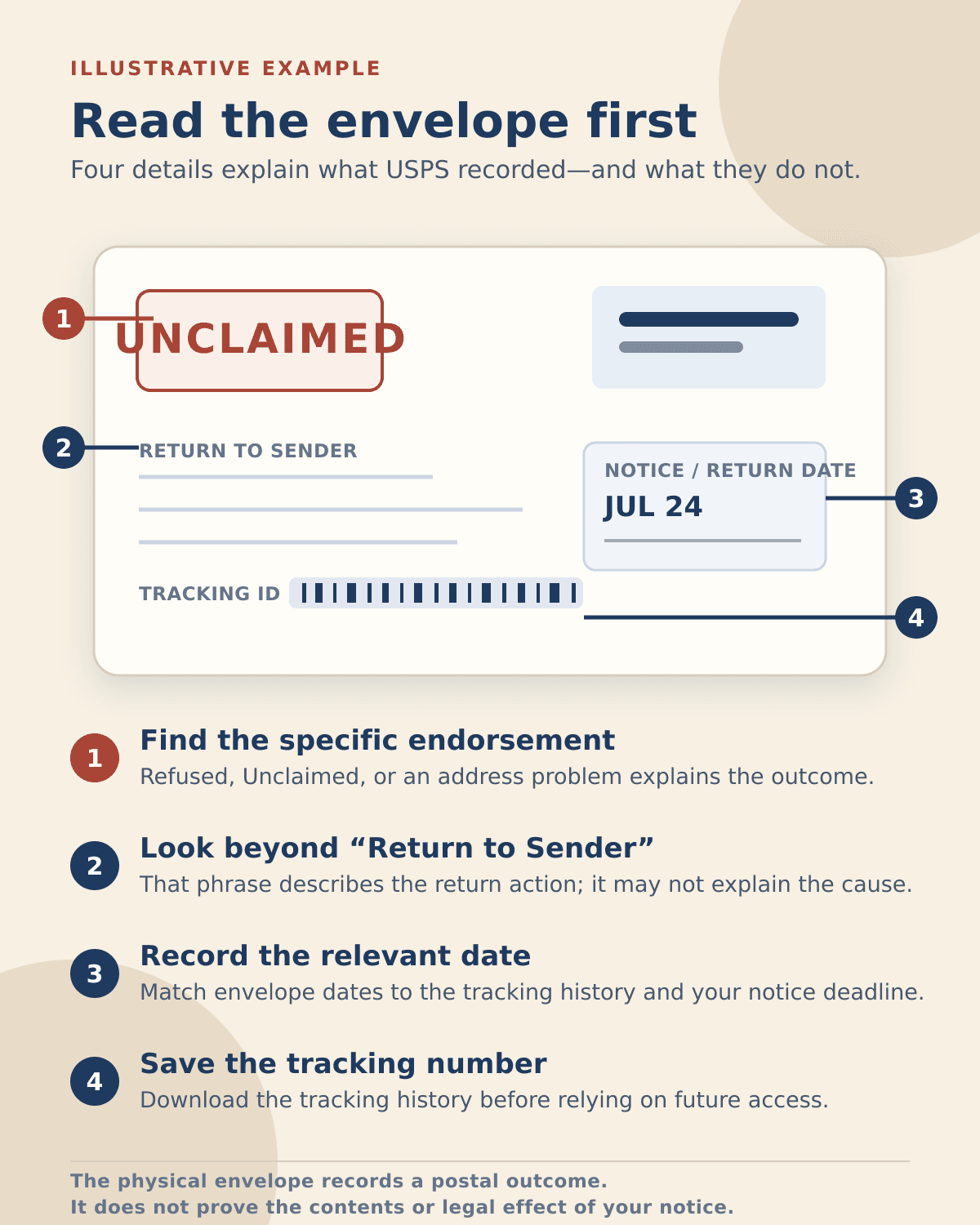
Refused and unclaimed are not the same#
Refused means the addressee turned the letter down when USPS offered it (DMM 508.1.1.2 (opens in new tab)). Before accepting Certified Mail, they can get the sender's name and address from the USPS employee (DMM 508.1.1.7). USPS returns refused mail (DMM 507.1.8.2 (opens in new tab)) without the 15-day hold, which applies to a piece that "cannot be delivered" and is left with a notice (DMM 508.1.1.7). Once signed for, Certified Mail can't be refused and returned postage-free (DMM 508.1.1.3).
Unclaimed means USPS left a notice and nobody collected the letter before the hold ran out. Don't read motive into it: the recipient may have ignored the notice, been away, or been unable to get to the Post Office.
Rules can treat the two differently. Ohio's civil rule says failure to claim certified mail "is not refusal of service" (Ohio Civ.R. 4.6(C) (opens in new tab)). Tennessee dropped a sentence from its rule in 2016 because an "unclaimed" notation "is not sufficient, by itself, to prove that service was 'refused'" (Tenn. R. Civ. P. 4.04, 2016 comment (opens in new tab)). Both are court-service rules, cited only to show the markings aren't interchangeable.
How long the unclaimed path takes#
USPS holds unclaimed Certified Mail for 15 days and returns it on the 16th day (USPS Certified Mail FAQ (opens in new tab)). The days are calendar days counted from the first delivery attempt, and a return date on a non-Postal business day moves to the next Postal business day (USPS notice and return dates (opens in new tab)). The carrier leaves two notices; the final one, 5 days after the first, is only a reminder.
Here is that path for a letter mailed on day 0 with a 30-day deadline from mailing, assuming a first attempt on day 4 (USPS gives First-Class Mail 1–5 days).
Unclaimed Certified Mail, day by day
Day | What happens | What it means for you |
|---|---|---|
0 | You mail the letter | Your 30-day window starts |
About 4 | First attempt; notice left | An attempt, not delivery |
About 9 | Final notice | A reminder, not another attempt |
About 19 | Day 15 of the hold | The recipient can still pick it up |
About 20 | USPS returns it (16th day) | Check tracking for the return |
About 21–25 | Envelope arrives back | About 5–9 days remain |
30 | Your window ends | Plan any second attempt to land before this |
The return travels back in the same mail class (USPS Return to Sender FAQ (opens in new tab)), so days 21–25 are a First-Class estimate, and by then about 5 to 9 days of a 30-day window remain. A refused letter starts back when it's refused, without the hold.
Compare a rule tied to mailing: under Arizona's landlord-tenant act, a certified notice is deemed received on actual receipt or "five days after the date the notice is mailed, whichever occurs first" (A.R.S. §33-1313(B) (opens in new tab)). That's day 5 here.
Does a returned envelope still count as notice?#
Real rules give opposite answers. Each row is one jurisdiction and one kind of notice — an example, not general law.
How real rules treat a returned envelope
Rule and what it covers | If refused | If unclaimed |
|---|---|---|
FRCP 5(b)(2)(C), federal court papers after the complaint | Service complete on mailing | Same |
26 U.S.C. §6212(b), IRS deficiency notices | Sufficient if sent to last known address | Same |
A.R.S. §33-1313(B), Arizona landlord-tenant notices | Deemed received 5 days after mailing, or on earlier receipt | Same |
Tex. Health & Safety Code §342.006(c), Texas city sanitation notices | Considered delivered | Same |
Ohio Civ.R. 4.6, Ohio court service | Clerk mails an ordinary copy on request; complete on mailing | Same, if that copy isn't returned |
Tenn. R. Civ. P. 4.04(11), Tennessee court service | Valid if the return receipt says so | Not enough by itself |
Tex. R. Civ. P. 107(c), Texas court service | Proof needs the addressee's signed return receipt | Same |
Under 26 U.S.C. §6212(b) (opens in new tab), an IRS deficiency notice mailed to the last known address is "sufficient," and Treasury explains that this holds "even if it is not received by the taxpayer" (64 FR 63768 (opens in new tab)). Mailing a return to the IRS is the other direction; see Certified Mail to the IRS.
Words to look for in your rule
Mailing-based: "complete upon mailing" (FRCP 5(b)(2)(C) (opens in new tab)) or "five days after the date the notice is mailed" (A.R.S. §33-1313(B) (opens in new tab)). The mailing date controls, so a return doesn't move it.
Delivery-proof: "the return receipt with the addressee's signature" (Tex. R. Civ. P. 107(c) (opens in new tab)) or "actual delivery" (Cal. Code Civ. Proc. §417.20(a) (opens in new tab), for a summons mailed to someone outside California). A refused or unclaimed letter has no signature to offer.
Names the outcome: a notice returned "refused" or "unclaimed" is "considered as delivered" (Tex. Health & Safety Code §342.006(c) (opens in new tab)); Ohio and Tennessee treat the two differently.
Contracts follow their notice clause. The Texas Real Estate Commission's resale contract says notices "are effective when mailed" (TREC form 20-19, paragraph 21 (opens in new tab)); other contracts may treat a refusal as receipt. Read yours.
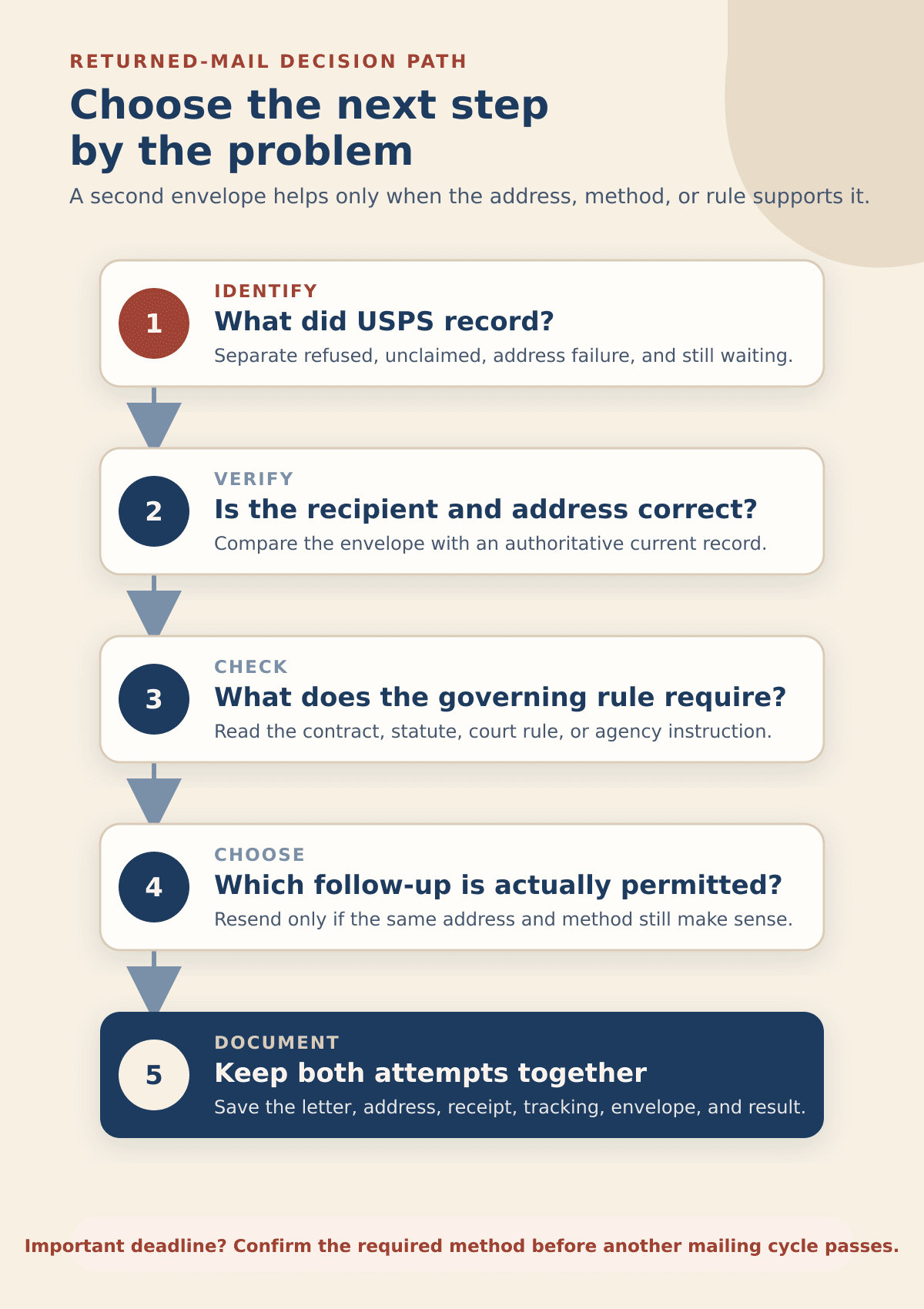
What to do next#
Where a deadline is running, do these within 48 hours.
- Identify the marking. Read the endorsement and full tracking history: refused, unclaimed, an address failure, or still waiting for pickup.
- Verify the address. Check it against the source your rule names, such as a "last known address" or the notice address in the lease or contract.
- Check the governing rule. Find the statute, court rule, contract clause, or agency instruction behind the notice, and sort it by its words: mailing-based, delivery-proof, or naming the outcome.
- Choose a permitted follow-up. Use only methods that rule allows, and add a second method where it helps.
- Document both attempts. Keep the second letter, address, receipt, tracking, and result with the first returned piece.
Should you send it again?#
Where your rule allows it, add a regular First-Class copy rather than only repeating the certified letter. New York's statute on serving eviction papers builds one in, requiring mailing "both by registered or certified mail and by regular first class mail" after papers are left with another person or posted (RPAPL §735 (opens in new tab)). In a government tax-sale case, the Supreme Court named a regular-mail resend as a reasonable step after an "unclaimed" return, because certified mail "might make actual notice less likely in some cases" (Jones v. Flowers, 547 U.S. 220 (2006) (opens in new tab)). That case concerns notice by the government, not private notices.
Postmarkr doesn't send Certified Mail. It sends standard USPS First-Class letters with mail-stream status and USPS scan updates when available. Use USPS or another qualified provider when the notice specifically requires Certified Mail.
If your rule requires proof that the regular copy was mailed, check what proof it accepts; a USPS Certificate of Mailing, for example, is sold only at a Post Office counter at the time of mailing.
To resend the certified letter itself, use a new envelope: a returned piece that was undeliverable or refused "may not be remailed unless it is placed in a new envelope or wrapper with a correct address and new postage" (DMM 508.1.1.6 (opens in new tab)). A second Certified piece makes sense when something changed: you corrected the address, or the recipient was away. When nothing changed, it may follow the same path and use up another 20 days.
Choose the follow-up by what went wrong
What went wrong | More useful follow-up |
|---|---|
Wrong or incomplete address | Correct and verify it, then resend |
Recipient temporarily away | Resend when timing allows |
Recipient refused | Keep the refusal record; check whether your rule counts it |
Letter went unclaimed | Add a permitted method instead of repeating the pickup step |
Formal service required | Use the method the court rule or statute authorizes |
Ordinary business follow-up | Send a clear follow-up by a method your agreement allows |
For other USPS and courier services, see alternatives to Certified Mail. Outside the mail, personal delivery, a process server or an authorized electronic notice may be options, alone or alongside a mailed copy. They aren't interchangeable: use only the ones your rule allows.
Keep one complete record#
Build one file before you resend or switch methods:
- The postmarked Certified Mail receipt
- The full tracking history, saved as a PDF or screenshot
- The returned envelope, still sealed, with every label, barcode, stamp, and handwritten marking
- A copy of the letter and every enclosure
- The address source you relied on and any later address check
- The Return Receipt, if one exists
- The date, method, address, and outcome of every follow-up
- Notes of related calls or messages
Save the tracking history now. USPS keeps Certified Mail tracking history for 2 years (USPS Tracking FAQ (opens in new tab)), and a dispute can arrive later than that.
Don't expect a signed Return Receipt for a refused or unclaimed letter. USPS keeps a delivery record that includes the recipient's signature, and you get a copy through a Return Receipt bought at mailing (DMM 503.3.1.1 (opens in new tab)). A Return Receipt "provides a mailer with evidence of delivery" (DMM 503.6.1.1). With no delivery, there is no signature to return, so your evidence is the receipt, the tracking history, and the envelope.
Certified Mail gives you "a mailing receipt and, upon request, electronic verification that an article was delivered or that a delivery attempt was made" (DMM 503.3.1.1). It records the envelope's journey, not what was inside. For what these records can prove in a dispute, see what Certified Mail can prove. If you need professional advice, bring this whole file, not just the tracking number.
Common mistakes after a returned letter#
Assuming an attempt completes notice. Whether it does depends on your rule's words. Arizona's landlord-tenant rule ties receipt to the mailing date; Texas court service by mail needs the addressee's signed return receipt.
Counting on a second delivery. The final notice is a reminder. The carrier doesn't have the letter with them when they leave it.
Assuming Certified Mail proves the contents. USPS records the envelope and its delivery outcome, not what was inside. Keep your own copy of the letter and enclosures.
Opening or throwing away the envelope. Its markings may be your clearest record of why delivery failed, and USPS won't let you re-mail it as it is.
Resending to the same bad address. A second letter to an address that already failed produces another return, not better evidence.
Waiting for the envelope. On the unclaimed path, USPS doesn't start the return until about day 20, and the envelope may not reach you until about day 25, leaving 5 to 9 days of a 30-day window. Act on the tracking status instead: turn on USPS text or email alerts, or text your tracking number to 28777 (Return to Sender FAQ (opens in new tab)). USPS closes alert requests 2 weeks after you make them (USPS Tracking FAQ (opens in new tab)), so sign up again after the final notice, around day 9, or check tracking yourself around days 19 to 20.
For how Certified Mail works from mailing to delivery, see the Certified Mail guide.