RATES
Mailing a letter within the U.S.#
Start with the weight of your finished envelope. For a qualifying machinable letter, these are the stamped and metered postage prices. Use the first row for a letter weighing 1 oz or less.
| Finished weight | Stamped | Metered |
|---|---|---|
| Over 0 through 1 oz | $0.82 | $0.78 |
| Over 1 through 2 oz | $1.11 | $1.07 |
| Over 2 through 3 oz | $1.40 | $1.36 |
| Over 3 through 3.5 oz | $1.69 | $1.65 |
Machinable domestic letters only, up to 3.5 oz. Nonmachinable letters need extra postage. Commercial/presort and special reply-mail rates are excluded. Source: USPS Notice 123, final July 2026 price files. Last verified September 10, 2026. | ||
Square, rigid or otherwise nonmachinable letters need additional postage. The domestic surcharge is $0.49. See totals with the surcharge included.
Each additional ounce adds $0.29, up to the letter maximum of 3.5 oz.
Weigh the finished piece after printing, inserting and sealing, because the envelope and its contents count together. First-Class letter-size pieces over 3.5 oz pay flat-size prices; check the applicable physical requirements as well as the weight.
| Mail type | Postage |
|---|---|
| Domestic postcard | $0.65 |
| Domestic large envelope, 1 oz | $1.69 |
| International letter, 1 oz | $1.75 |
Domestic cards and flats must meet their USPS category requirements. International price is for a machinable letter to an eligible destination; eligible correspondence and nondutiable documents only, no merchandise. Heavier pieces cost more. Source: USPS Notice 123, final July 2026 price files: FCM & EDDM - Retail.csv and FCMI Ltrs.csv. Last verified September 10, 2026. | |
Find your rate: large envelopes · international letters · all detailed rate tables.
METERED
Why metered letters cost less than stamps#
A metered 1 oz letter costs $0.78 — four cents less than a Forever stamp.
USPS offers the metered letter price through postage meters and approved online postage systems. Use the metered column for your finished letter’s weight, up to 3.5 oz.
Metered postage is different from First-Class Presort. For a qualifying business mailing, compare the preparation requirements and total costs in our Commercial First-Class Mail rates guide.
At 250 qualifying 1 oz letters a month, the postage difference is $10; at 1,000 letters, it is $40. Compare that saving with any meter rental or online postage account fees before choosing a postage service.
Metered postage is the discount hiding in plain sight: same delivery, same envelope, four cents less on every letter.
Two things metered pricing does not change: delivery speed and add-on fees. If a letter needs proof — Certified Mail, Return Receipt — those fees stack on top of whichever postage rate you use. The certified mail cost guide prices those combinations.
FORMATS
How much are postcards and large envelopes (flats)?#
A stamped postcard is $0.65, and flats run $1.69 to $5.24 depending on weight.
Postcards have separate size and thickness requirements for the card price. Large envelopes must meet the flat size, flexibility and uniform-thickness rules to use flat postage. Check the First-Class size and weight guide before choosing the rate for your finished piece.
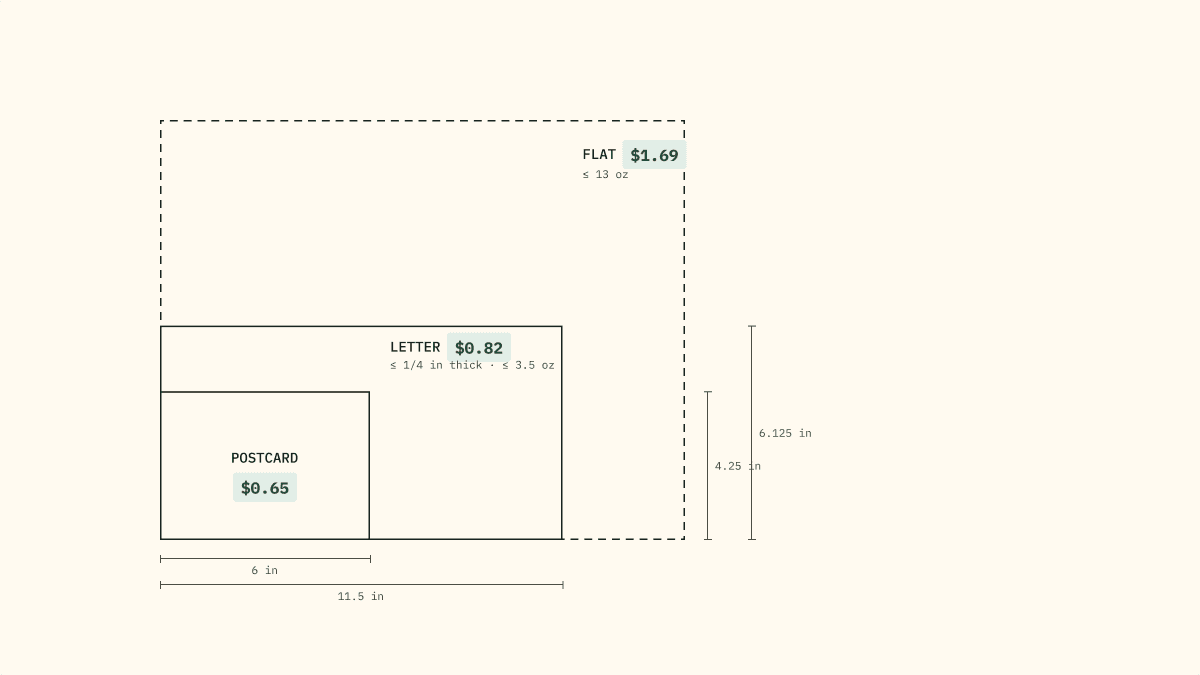
Domestic letter prices apply up to 3.5 oz. First-Class letter-size pieces over that weight pay flat-size prices, and the domestic First-Class limit for letters and flats is 13 oz. A larger envelope must also qualify for flat pricing; size and weight alone are not enough. If the piece falls outside these limits, ask USPS which service fits it. See the USPS rates reference for current mailing prices.
Sending a letter internationally#
- Up to 1 oz, any country: one Global Forever stamp (the round one, $1.75) covers a standard letter or postcard to Canada, Mexico or anywhere else.
- No Global Forever stamp? Regular Forever stamps count at their current value, $0.82 each, so a 1 oz letter takes three ($2.46).
- Heavier letters: only three prices — Canada, Mexico and everywhere else (2 oz: $2.35, $2.60, $3.50). See the international letter table.
- Stiff, square or lumpy envelope? It costs $0.49 more ($2.24 at 1 oz; three Forever stamps still cover it). A letter with only correspondence or paper documents inside (no stickers, bookmarks or trading cards) needs no customs form; goods aren't allowed in letters.
See international letter rates · nonmachinable letter totals · international postcards · international large envelopes.
Before buying postage, check USPS country price groups (opens in new tab) · country conditions (opens in new tab) · content restrictions (opens in new tab) · physical standards (opens in new tab) · international service alerts (opens in new tab).
CHOOSING
How to choose the right First-Class rate#
- Identify whether your piece qualifies for postcard, letter or flat pricing. Check dimensions, thickness and the other physical requirements in the linked size guide.
- Weigh the finished piece — printed, inserted, sealed.
- Use the rate in effect on the day USPS accepts the mail, not the day you print postage.
- The nonmachinable totals in the reference tables already include the letter surcharge; do not add it again. Proof services like Certified Mail charge separate fees on top of postage.
For a printed-and-mailed letter, use the mail cost calculator to estimate printing, envelope, postage and service costs from your PDF page count.
ONLINE
Sending First-Class letters online#
If the real cost of your mail is the trip — printing, stuffing, stamping, and standing in line — the rate table isn't the whole answer.
Postmarkr sends standard First-Class letters online to U.S. addresses: upload a PDF, add recipients, and see the full price before checkout — from $2.05 per letter, covering printing, the envelope, First-Class postage, and handling. No subscription, no minimums. Use the USPS rates on this page when you're doing the mailing yourself; use the all-in price when you'd rather not.
How the Forever stamp reached $0.82#
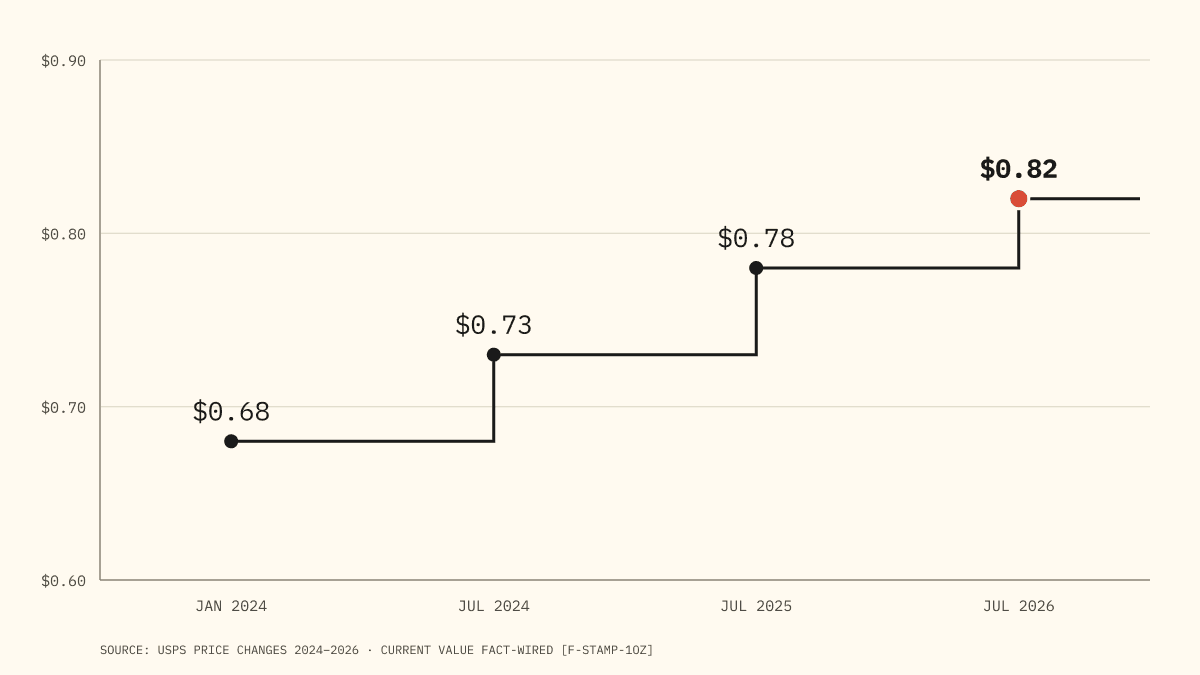
A standard Forever stamp keeps its value for a qualifying 1 oz domestic First-Class letter. One bought for $0.78 still covers the current base postage; extra weight or nonmachinable characteristics can require additional postage.
First-Class Mail rates have now risen three Julys in a row: the Forever stamp went from $0.68 to $0.73 in 2024, to $0.78 in 2025, and to $0.82 now. The stamp price history lists every letter rate since 1885.
Complete First-Class rate reference#
Open the table for your mail type. Prices are postage only; each table includes its effective date, source and eligibility notes.
Domestic nonmachinable letters
| Finished weight | Stamped total | Metered total |
|---|---|---|
| Over 0 through 1 oz | $1.31 | $1.27 |
| Over 1 through 2 oz | $1.60 | $1.56 |
| Over 2 through 3 oz | $1.89 | $1.85 |
| Over 3 through 3.5 oz | $2.18 | $2.14 |
Ordinary eligible letters only, through 3.5 oz. Nonmachinable totals include one letter surcharge; do not add it again. If machinability is unknown, these are conditional prices: confirm machinable or nonmachinable status before choosing one. Special reply-mail arrangements, international and commercial/presort rates are excluded. Letter-size pieces over 3.5 oz use flat prices only if they meet flat eligibility; weight alone is insufficient. Rules: USPS DMM 101.1.1–1.2 and 133.1.1–1.2, 1.7. Source: USPS Notice 123, final July 2026 price files: FCM & EDDM - Retail.csv. Last verified September 10, 2026. | ||
Domestic large envelopes: all 13 weight bands
| Finished weight | Postage total |
|---|---|
| Over 0 through 1 oz | $1.69 |
| Over 1 through 2 oz | $1.98 |
| Over 2 through 3 oz | $2.27 |
| Over 3 through 4 oz | $2.56 |
| Over 4 through 5 oz | $2.85 |
| Over 5 through 6 oz | $3.14 |
| Over 6 through 7 oz | $3.43 |
| Over 7 through 8 oz | $3.72 |
| Over 8 through 9 oz | $4.02 |
| Over 9 through 10 oz | $4.32 |
| Over 10 through 11 oz | $4.62 |
| Over 11 through 12 oz | $4.93 |
| Over 12 through 13 oz | $5.24 |
All 13 weight bands for eligible domestic retail flats. Prices require flexible, rectangular, uniformly thick flats meeting USPS standards; dimensions and weight alone do not establish eligibility. Rigid or uneven pieces may require parcel pricing. Letter-size pieces over 3.5 oz use these prices only when flat-eligible. The letter nonmachinable surcharge does not apply to flats. Do not extrapolate a constant increment. Above 13 oz, use another eligible service; international and commercial prices are outside this table. Rules: USPS DMM 101.1.1c, 2.1, 2.3–2.4, 6.3.2; 133.1.1–1.2. Source: USPS Notice 123, final July 2026 price files: FCM & EDDM - Retail.csv (July 8 file; July 12 effective schedule). Last verified September 8, 2026. | |
International letters by weight
| Finished weight | Canada | Mexico | Other eligible destinations (groups 3–9) |
|---|---|---|---|
| Over 0 through 1 oz | $1.75 | $1.75 | $1.75 |
| Over 1 through 2 oz | $2.35 | $2.60 | $3.50 |
| Over 2 through 3 oz | $2.95 | $3.50 | $5.25 |
| Over 3 through 3.5 oz | $3.50 | $4.15 | $5.75 |
Machinable letters only, up to 3.5 oz. Eligible correspondence and nondutiable documents only; no merchandise. Canada is price group 1; Mexico is group 2. Other eligible destinations combine groups 3–5 and 6–9, whose prices match in this schedule. Price groups do not guarantee service availability: check USPS country conditions and international service alerts. Source: USPS Notice 123, final July 2026 price files: FCMI Ltrs.csv. Last verified September 10, 2026. | |||
International nonmachinable letters
| Finished weight | Canada total | Mexico total | Other eligible destinations (groups 3–9), total |
|---|---|---|---|
| Over 0 through 1 oz | $2.24 | $2.24 | $2.24 |
| Over 1 through 2 oz | $2.84 | $3.09 | $3.99 |
| Over 2 through 3 oz | $3.44 | $3.99 | $5.74 |
| Over 3 through 3.5 oz | $3.99 | $4.64 | $6.24 |
Letters only, up to 3.5 oz. These totals include one $0.49 international nonmachinable surcharge; do not add it again. Eligible correspondence and nondutiable documents only; no merchandise. Canada is price group 1; Mexico is group 2. Other eligible destinations combine groups 3–5 and 6–9, whose prices match in this schedule. Price groups do not guarantee service availability: check USPS country conditions and international service alerts. Source: USPS Notice 123, final July 2026 price files: FCMI Ltrs.csv; letter price plus the international nonmachinable surcharge. Last verified September 10, 2026. | |||
International postcards
| Mail type | Postage |
|---|---|
| Qualifying postcard, eligible destinations | $1.75 |
Card-price eligibility follows USPS IMM 241.221 and 241.224, which differ from domestic card standards. Eligible correspondence and nondutiable documents only; no merchandise. Canada is price group 1; Mexico is group 2. Other eligible destinations combine groups 3–5 and 6–9, whose prices match in this schedule. Price groups do not guarantee service availability: check USPS country conditions and international service alerts. Source: USPS Notice 123, final July 2026 price files: FCMI Ltrs.csv, postcards row. Last verified September 10, 2026. | |
International large envelopes by weight
| Finished weight | Canada | Mexico | Other eligible destinations (groups 3–9) |
|---|---|---|---|
| Over 0 through 1 oz | $3.30 | $3.30 | $3.30 |
| Over 1 through 2 oz | $3.75 | $4.35 | $4.65 |
| Over 2 through 3 oz | $4.25 | $5.45 | $6.05 |
| Over 3 through 4 oz | $4.65 | $6.45 | $7.35 |
| Over 4 through 5 oz | $5.15 | $7.55 | $8.75 |
| Over 5 through 6 oz | $5.65 | $8.65 | $10.15 |
| Over 6 through 7 oz | $6.15 | $9.75 | $11.55 |
| Over 7 through 8 oz | $6.65 | $10.85 | $12.95 |
| Over 8 through 12 oz | $7.60 | $13.00 | $15.75 |
| Over 12 through 15.994 oz | $8.55 | $15.15 | $18.55 |
Qualifying flat-size envelopes only, up to 15.994 oz. Flats must be flexible, rectangular and uniformly thick; use USPS IMM 241.23 to confirm eligibility. Eligible correspondence and nondutiable documents only; no merchandise. Canada is price group 1; Mexico is group 2. Other eligible destinations combine groups 3–5 and 6–9, whose prices match in this schedule. Price groups do not guarantee service availability: check USPS country conditions and international service alerts. Source: USPS Notice 123, final July 2026 price files: FCMI Flats.csv. Last verified September 10, 2026. | |||
Full rate table: USPS Notice 123 retail prices (opens in new tab). Physical requirements: DMM 101 physical standards (opens in new tab).
CONCLUSION
Use a standard machinable envelope whenever you can
For a qualifying 1 oz domestic letter, postage is $0.82 stamped or $0.78 metered. Letter-size pieces with nonmachinable characteristics may need the additional $0.49 surcharge; check the finished envelope and contents against USPS requirements.
Before mailing anything unusual, weigh and measure the finished piece and check the applicable physical standards. These rate tables use the July 12, 2026 schedule. Check USPS Notice 123 for the current price before buying postage.