New Mover Direct Mail: Reach Homeowners Before Your Competitors

New movers spend $9,000–$12,000 on home services in 6 months. Learn how to reach them first with EDDM and targeted direct mail campaigns.

Nathan Crank·Founder, Postmarkr

Every year, roughly 12% of Americans move — about 40 million people changing addresses and looking for new service providers (U.S. Census Bureau). In the first six months after a move, homeowners spend an estimated $9,000 to $12,000 on home services, furniture, and appliances (Taylor Research, via Triadex).

Industry surveys suggest that a significant majority of new movers use the first vendor that contacts them. Whether the exact figure is 70% or 85%, the pattern is consistent: new homeowners are actively searching for providers and tend to stick with whoever reaches out first.

That makes new movers the single highest-value targeting segment for home services direct mail. This guide covers how to reach them across every trade — from HVAC and plumbing to roofing and landscaping. For the full home services playbook, see the complete guide to direct mail for home services.

Why New Movers Are Worth More Than Any Other Lead#

New movers are not just "another lead." They represent a fundamentally different acquisition opportunity than standard EDDM or Google Ads prospects.

They have no existing vendor relationships. A homeowner who has lived at the same address for 10 years already has a plumber, an HVAC tech, and a landscaper. A new mover has none. You are not competing against an incumbent — you are filling a vacuum.

They are actively spending. The $9,000–$12,000 average spend in the first six months is not hypothetical future revenue. New movers are buying right now: changing locks, servicing HVAC systems, starting lawn care, inspecting roofs, and scheduling pest control.

They become long-term customers. Vendor-reported data from Triadex suggests new movers engaged early are up to 5x more likely to become repeat customers. This makes sense — when you are the first plumber or HVAC tech a homeowner trusts, you become their default for years.

They respond at higher rates. New mover direct mail typically generates 20–30% higher response rates compared to standard EDDM campaigns (vendor-reported, Triadex). The reason is simple: standard EDDM hits homeowners who already have vendors. New movers are actually looking for you.

The Timing Window: First 30–60 Days#

The optimal window to reach new movers is the first 30 to 60 days after they move in. After 90 days, most new homeowners have already chosen their primary service providers, and your mail becomes just another postcard.

This creates an urgency advantage for direct mail over digital channels. New movers do not search for "plumber near me" on day one — they search when something breaks. Direct mail reaches them proactively during the decision window, before the emergency forces a rushed Google search.

How to identify new movers by trade#

Each home services trade has slightly different new mover dynamics:

  • HVAC: New homeowners typically schedule an inspection or tune-up within the first 60 days, especially if moving into an older home. Mail your "new homeowner HVAC inspection" offer within the first 30 days. See the HVAC seasonal playbook for month-by-month timing.
  • Plumbing: Fixtures, water heaters, and drain issues surface quickly in a new home. Position yourself as the "get to know your plumbing" expert with a first-service discount. See the plumber's guide to direct mail.
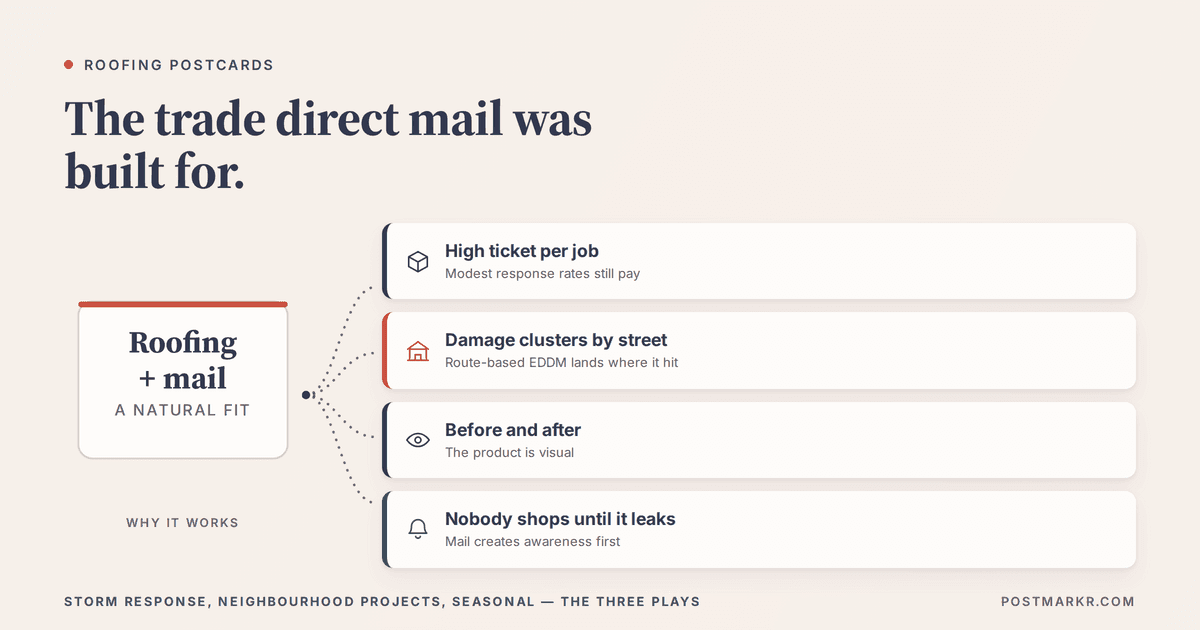
  • Roofing: New homeowners who bought older homes often need roof inspections. Offer a free inspection — even if no work is needed, you become their roofer when something happens. See roofing postcards that get calls.
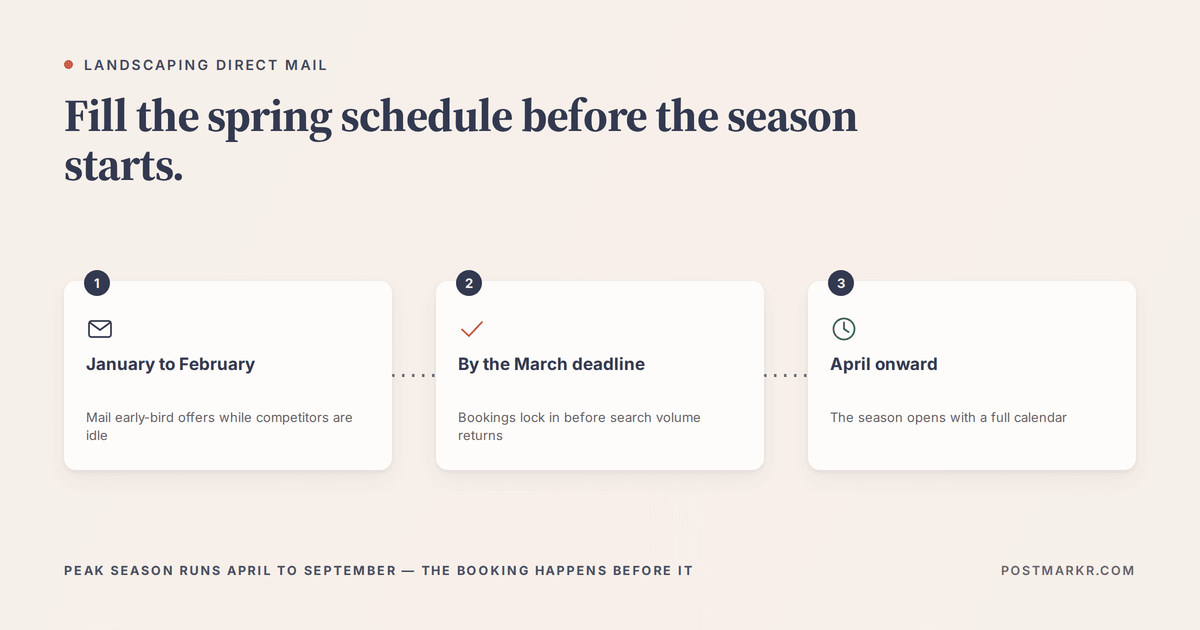
  • Landscaping: Lawn care is one of the first ongoing services new homeowners establish. A "welcome to the neighborhood" postcard with a first-mow discount locks in recurring revenue. See the landscaping direct mail guide.
  • Pest control: New movers inherit whatever pest situation the previous owner left behind. "New home, new start — schedule your first treatment" messaging works well.
  • Electrician: Panel inspections, outlet upgrades, and smart home wiring are common new-homeowner projects.
  • Fence company: New homeowners with pets or children prioritize fencing early.
  • Handyman: The to-do list after a move is long. Position yourself as the one call for everything.

Two Approaches: EDDM vs Targeted New Mover Lists#

EDDM for new construction and high-turnover areas#

EDDM (Every Door Direct Mail) at $0.247 per piece is the most cost-effective way to reach new movers in bulk. While EDDM does not specifically target new movers, you can approximate it by selecting routes strategically:

  • New construction developments: Subdivisions with active building generate a steady stream of new homeowners. EDDM these routes monthly.
  • High-turnover neighborhoods: Areas near military bases, corporate campuses, or with high rental-to-ownership conversion rates see frequent moves. USPS route data shows household density — look for routes where the mix is shifting.
  • Seasonal move-in clusters: The peak moving season runs May through September. Increase your EDDM frequency during these months for any route in your service area.

A 5,000-piece EDDM campaign costs roughly $2,000 all-in ($0.40/piece including printing). At a conservative 1% response rate, that is 50 leads at $40 each. For new mover–heavy routes, response rates tend to run higher because more recipients are actively seeking services.

For a complete breakdown of EDDM mechanics, see the EDDM guide. For current postage rates, see the EDDM rates guide.

Targeted new mover lists#

For precise targeting, you can purchase new mover mailing lists from data providers that track address changes through USPS National Change of Address (NCOA) data, property deed transfers, and utility connections.

Targeted new mover mail is more expensive per piece than EDDM — you need a mailing list and First-Class or Marketing Mail postage — but the response rates are significantly higher. The ANA/DMA reports a 4.4–4.9% response rate for targeted prospect mail versus 0.5–2% for EDDM.

When to use targeted lists vs EDDM:

  • Use EDDM when you want to blanket new construction areas or high-turnover neighborhoods at the lowest cost.
  • Use targeted lists when you want to reach every new mover in your service area regardless of neighborhood, or when your service area is too spread out for efficient EDDM routing.

What to Put on a New Mover Postcard#

New mover postcards require different messaging than standard direct mail. These homeowners do not need to be convinced that they need services — they need to be convinced to choose you.

  • "Welcome to the neighborhood" framing: Position yourself as a local expert, not a salesperson. This builds trust faster than a discount-first approach.
  • Specific first-service offer: "$50 off your first service call" or "Free home inspection" gives them a reason to act now rather than filing the postcard for later.
  • Full service list: New movers do not know what you do. If you are a plumber who also installs water heaters, gas lines, and sump pumps, say so. They may need all of it.
  • Phone number as the largest element: New movers will pin your postcard to the fridge. Make the number readable from across the room.
  • Your service area: "Serving [Neighborhood], [City], and surrounding areas" reassures them that you are genuinely local.
  • Google review count or rating: "4.8 stars, 200+ reviews" provides instant social proof for someone who has no word-of-mouth to rely on.

The Cost Math: New Mover Campaigns vs Google Ads#

New movers searching online face the same expensive Google Ads market as every other lead:

TradeGoogle Ads CPLEDDM CPL (at 1%)Savings
HVAC$104$4062%
Plumbing$129$4069%
Roofing$228$4082%
Landscaping$88$4055%

Sources: PPC Chief 2026, PerfoAds 2026, LocaliQ 2025, Evergrow Marketing 2024.

But the real advantage is not just cost — it is timing. Google Ads only reach homeowners who are actively searching. Direct mail reaches new movers during their decision window, before they have chosen anyone. You are creating demand, not competing for it.

Building a New Mover Campaign Calendar#

New movers arrive year-round, but volume peaks May through September. Here is how to structure your campaigns:

  • January–February: Mail new construction areas where homes closed in Q4. These homeowners are settling in and starting their vendor search.
  • March–April: Increase frequency as spring moving season begins. Add seasonal service hooks — HVAC tune-ups, landscaping startup, pest prevention.
  • May–September: Peak moving months. Run monthly EDDM drops to high-turnover routes. Consider biweekly drops in new construction areas.
  • October–November: Target fall movers with winterization messaging — furnace checks, gutter cleaning, pipe insulation.
  • December: Lower volume, but holiday movers are an underserved segment. A "welcome" postcard in December stands out because nobody else is mailing.

Getting Started with Postmarkr#

Postmarkr makes it easy to target new mover areas with EDDM. Select your carrier routes based on new construction activity or neighborhood turnover, upload your "welcome to the neighborhood" postcard design, and reach every household on those routes.

For current EDDM postage rates, see the EDDM rates guide. For a full overview of how EDDM works, see the complete EDDM guide.

Frequently Asked Questions#

How soon after someone moves should I send direct mail?#

The optimal window is 30 to 60 days after move-in. After 90 days, most new homeowners have already selected their primary service providers.

Is EDDM or targeted mail better for reaching new movers?#

EDDM is best for blanketing new construction areas and high-turnover neighborhoods at $0.247 per piece. Targeted new mover lists are better when you want to reach every new mover in your service area regardless of location, at higher cost but with higher response rates.

How much do new movers spend on home services?#

Industry research estimates that new homeowners spend $9,000 to $12,000 on home services, furniture, and appliances within the first six months of moving in (Taylor Research, via Triadex).

What should I put on a new mover postcard?#

Lead with "Welcome to the neighborhood," include a specific first-service discount, list all your services, make your phone number the largest element, and include your Google review rating for social proof.

How often should I mail to new mover areas?#

During peak moving season (May–September), mail monthly to high-turnover routes. For new construction developments with ongoing closings, consider biweekly drops.

Reach Every Homeowner on Your Routes

Select your postal routes, upload your postcard design, and mail to every household — all from one platform.

Mail Your First Postcard
ready

Related Topics

Procedures

Comparisons