Key takeaways
- Put the return address in the top left, the recipient address in the lower center, and postage in the top right.
- Write the recipient block with a name, complete delivery line, and city, state, and ZIP Code line.
- Include apartment, suite, unit, floor, and directional details when they are part of the mailing address.
- Keep the delivery block dark, left-aligned, parallel to the bottom edge, and clear of decorative printing.
- Address verification can catch formatting and missing-unit problems, but it cannot guarantee delivery or receipt.
To address an envelope, write your return address in the top left, the recipient's address in the center of the front, and put the stamp in the top right.
- Return address — your name and complete mailing address.
- Recipient's address — their name and complete delivery address.
- Postage — enough for the letter's weight, size, and shape.
- Final check — complete, legible, and current before it goes in the mail.
The recipient block usually takes three lines. Add a fourth only when you need an attention or secondary line.
Line | Example |
|---|---|
Name | JORDAN LEE |
Delivery line | 123 MAIN ST APT 4B |
City, state, ZIP | CHICAGO IL 60601 |
Use dark ink on a light envelope, include the apartment or unit, and keep every line left-aligned and easy to read.
That makes the envelope ready for USPS processing — which is not the same as guaranteed delivery. The recipient may have moved, refuse the letter, or no longer receive mail there.
This guide covers both halves: the format that gets a letter into the mailstream, and the delivery risks no format can fix.
How do you address an envelope?#
Start with the recipient block, because it carries the detail USPS uses to route the piece. Keep the return address and postage clear of it, in the positions shown above.
USPS shows the same placement in its domestic letter instructions (opens in new tab). All three zones stay on the front of the envelope.
One Forever stamp covers a standard one-ounce letter. If weight, size, or shape leaves you unsure that's enough, check the current USPS rates before mailing.
The recipient block has three jobs: name the recipient, identify the exact delivery point, and give USPS the correct city, state, and ZIP Code. For most residential addresses, three lines do all three:
Line | What goes there |
|---|---|
Name | RECIPIENT NAME |
Delivery line | STREET NUMBER STREET NAME APT OR UNIT |
City, state, ZIP | CITY ST ZIP CODE |
Use the recipient's current mailing address, not one copied from an old invoice or contact record. Addressing is one step of a larger process — the guide to sending a letter covers the rest, from postage to drop-off.
Check your envelope before you mail it#
Give the envelope five quick passes before it leaves your hands. Each pass catches a different kind of problem.
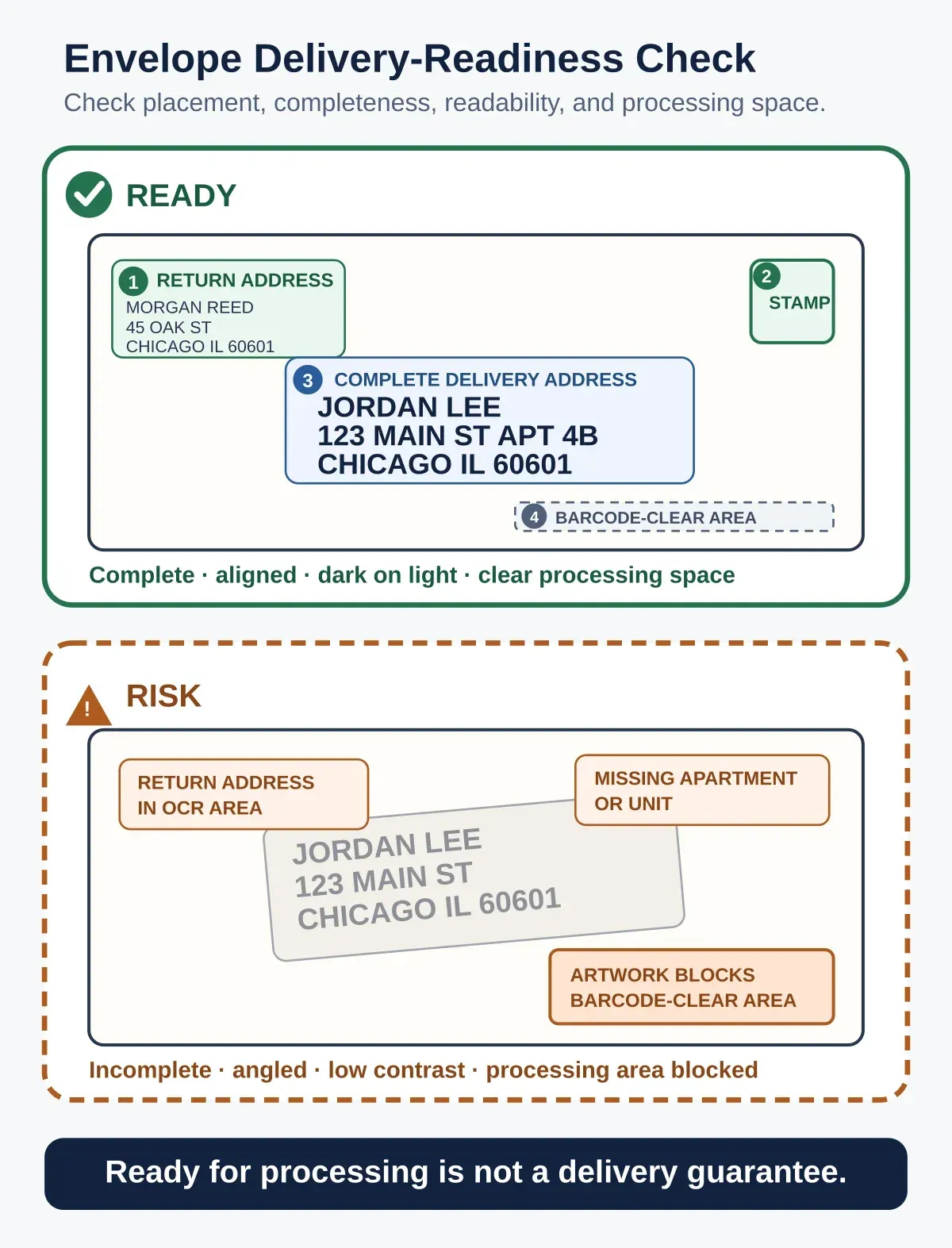
- Placement — sender top left, recipient lower center, postage top right, with nothing competing against the delivery block.
- Completeness — recipient name, delivery line with any unit number, and the city, state, and ZIP Code are all present.
- Readability — dark ink on a light background, left-aligned, lines parallel to the bottom edge.
- Processing space — no printing or artwork in the lower-right barcode area or crowding the address block.
- Verification — confirm the city, state, and ZIP with USPS ZIP Code Lookup (opens in new tab), and fix any warning before sending.
The bar comes from USPS Publication 28 readability guidance (opens in new tab): a complete address, dark ink on a light background, a uniform left margin, and lines parallel to the bottom edge.
The same guidance identifies an OCR read area and a lower-right barcode-clear area. Keep decorative printing away from the delivery block and out of that clear space.
Ready for processing is not a delivery guarantee. What the five passes can't see — a move, a refusal, a vacant address — is covered below.
Build the recipient address line by line#
A domestic address block reads bottom-up in specificity: the last line routes the letter to a city, the delivery line narrows it to one delivery point, and the top line names who it's for.
USPS prefers uppercase letters and one uniform left margin (opens in new tab), and punctuation can usually be dropped from a domestic address block.
Put the apartment, suite, or unit on the delivery line#
Use the real unit designator when you know it — APT, STE, UNIT, FL, or RM — and put it at the end of the delivery address line (opens in new tab):
Line | Example |
|---|---|
Name | ALEX RIVERA |
Delivery line with unit | 456 OAK AVE APT 12 |
City, state, ZIP | DENVER CO 80203 |
If the delivery line runs too long, move the unit information to the line immediately above the street address. Don't swap a known APT or STE for # just to save characters.
Put an attention line above the company#
Use ATTN when a letter goes to a specific person or department inside an organization. USPS places the attention line above the company name (opens in new tab):
Line | Example |
|---|---|
Attention line | ATTN JORDAN LEE |
Company | ACME COMPANY |
Delivery line | 123 MAIN ST STE 400 |
City, state, ZIP | CHICAGO IL 60601 |
For court correspondence, see our guide to addressing a letter to a judge.
Write the box line as PO BOX#
Write a Post Office Box as PO BOX followed by the number:
Line | Example |
|---|---|
Name | JORDAN LEE |
Box line | PO BOX 118 |
City, state, ZIP | CHICAGO IL 60690 |
USPS standardizes the line as PO BOX (opens in new tab). A private mailbox at a shipping store is not a USPS PO Box — it usually takes PMB or # after the street address instead.
If the letter needs Certified Mail or another accountable service, PO Box rules get their own treatment in the Certified Mail to a PO Box guide.
Use one intended delivery address whenever possible. If you must show both a street address and a PO Box, the line immediately above the city, state, and ZIP controls delivery (opens in new tab) — and the ZIP Code must match it.
The address problems that delay, misroute, or return mail#
Address failures fall into two groups: errors you can fix before mailing, and recipient conditions that formatting can't reach.
The fixable group is familiar by now. A missing apartment number identifies the building but not the unit. An illegible or incorrect street line hides the delivery point. A missing ZIP Code can force manual lookup and slow processing.
Each has the same cure: write it clearly, confirm the details, and add the exact unit designator before the letter enters the mailstream.
The second group belongs to the recipient. USPS lists moved recipients, refused letters, unclaimed mail, and missing receptacles among the reasons mail can be undeliverable (opens in new tab) — right alongside bad addresses.
USPS also doesn't promise one outcome for every problem. Depending on mail class and circumstances, it may forward the piece, return it, or treat it as dead mail.
The return address is your safety net: USPS recommends one so undeliverable mail can come back to you (opens in new tab). Leaving it off doesn't cause nondelivery — it just removes the recovery path when something else goes wrong. If the letter is someone else's, such as your executive's or a client's, see whose return address goes on the envelope.
Mailing something with a deadline or legal weight? Certified Mail adds a mailing receipt and, upon request, electronic verification of delivery or attempted delivery. If you need a copy of the delivery record, purchase a Return Receipt when you mail the letter.
How to address an envelope with an apartment, PO Box, c/o, or military address#
Don't force every destination into the three-line street format — match the pattern to whatever actually identifies the delivery point: a unit, a box, a host, or a military routing.
Situation | Address pattern | Use it when |
|---|---|---|
Apartment, suite, or unit | Recipient; street plus APT, STE, or UNIT; city/state/ZIP | One street address serves more than one unit |
USPS PO Box | Recipient; PO BOX number; city/state/ZIP | USPS delivers to a Post Office Box |
In care of | Recipient; C/O host; host's street address; city/state/ZIP | Another person or business receives mail for the recipient |
Attention | ATTN person or department; company; delivery address; city/state/ZIP | Mail goes to someone inside an organization |
APO, FPO, or DPO | Recipient; unit and box; APO/FPO/DPO plus AE, AP, or AA and ZIP | Mail goes through the military or diplomatic postal system |
For military and diplomatic mail, follow USPS's APO/FPO/DPO addressing guide (opens in new tab): the recipient's full name, unit and box, the APO/FPO/DPO designation with AA, AE, or AP, and the ZIP Code. No foreign city or country name.
These are the USPS patterns. Mailing services don't all accept APO, FPO, or DPO destinations, so check before sending through one.
What address verification can — and cannot — tell you#
Address verification checks the address record, not the human outcome.
It can standardize spelling and abbreviations, append missing postal detail, and flag problems worth stopping for: a missing apartment number, or an address USPS reports as undeliverable as entered.
Its limits are just as specific. A building can be deliverable while the unit is missing. A location can be real without receiving USPS delivery. And no clean result can prove the named person is still there.
No stamp, envelope, or printer handy? Postmarkr checks the address, then prints and mails the letter for you — a one-page letter is $2.05.
Upload the document, enter the recipient, review the details, and send the letter online.
Either way, the finish is the same: check the format, fix the warnings you can see, include a return address — and don't confuse readiness with proof of delivery.