An unused US stamp marked A through H has a fixed postage value. It does not rise with today’s letter price. Match the exact version below: the small words matter, especially on B, F, G and H issues.
These are postage values, not collector prices. For stamps marked Forever or a service such as Additional Ounce, use our old-stamp and Forever guide.
A–H stamp postage values#
| Stamp or wording | Postage value | What to check |
|---|---|---|
| A stamp or stamped envelope | $0.15 | Match the A issue. |
| B stamp or stamped envelope | $0.18 | Different from the B postal card. |
| B postal card | $0.12 | Prepaid stationery; keep the card intact. |
| C stamp or stamped envelope | $0.20 | Match the C issue. |
| D stamp or stamped envelope | $0.22 | Match the D issue. |
| E stamp | $0.25 | Match the E issue. |
| F stamp or F Flag | $0.29 | Different from F Make-Up Price. |
| F Stamp Make-Up Price | $0.04 | Adds only the makeup amount. |
| G / Old Glory / U.S. Addresses Only | $0.32 | Different from the other G versions. |
| G / Old Glory / Postcard Price Only | $0.20 | Read the postcard wording. |
| G / Old Glory / First-Class Presort Only | $0.25 | Presort issue: ask USPS about permit use. |
| G Stamp Make-Up Price | $0.03 | Adds only the makeup amount. |
| H Stamp First-Class Mail Price | $0.33 | U.S. Addresses Only issue. |
| H Stamp Make-Up Price | $0.01 | Adds only the makeup amount. |
For the matching unused issue. Stationery stays intact; presort postage needs eligibility checks. These are fixed postage values, not collector values or today’s letter prices. Source: USPS Quick Service Guide 604a; checked November 10, 2026. | ||
Source: USPS’s illustrated nondenominated-postage reference (opens in new tab), checked November 10, 2026. Match the actual design there before using an uncertain stamp.
Read the letter and the qualifying words#
Look for “Make-Up Price,” “Postcard Price Only” or “First-Class Presort Only,” as well as the large letter. A regular G contributes 32 cents; a G makeup stamp contributes 3 cents. A letter alone is not enough to choose a row.
The B postal card is the card itself, with postage printed on it. Its 12-cent indicium is not a loose stamp to cut out and put on an envelope. The same distinction applies to the stamped-envelope entries: use the intact stationery.
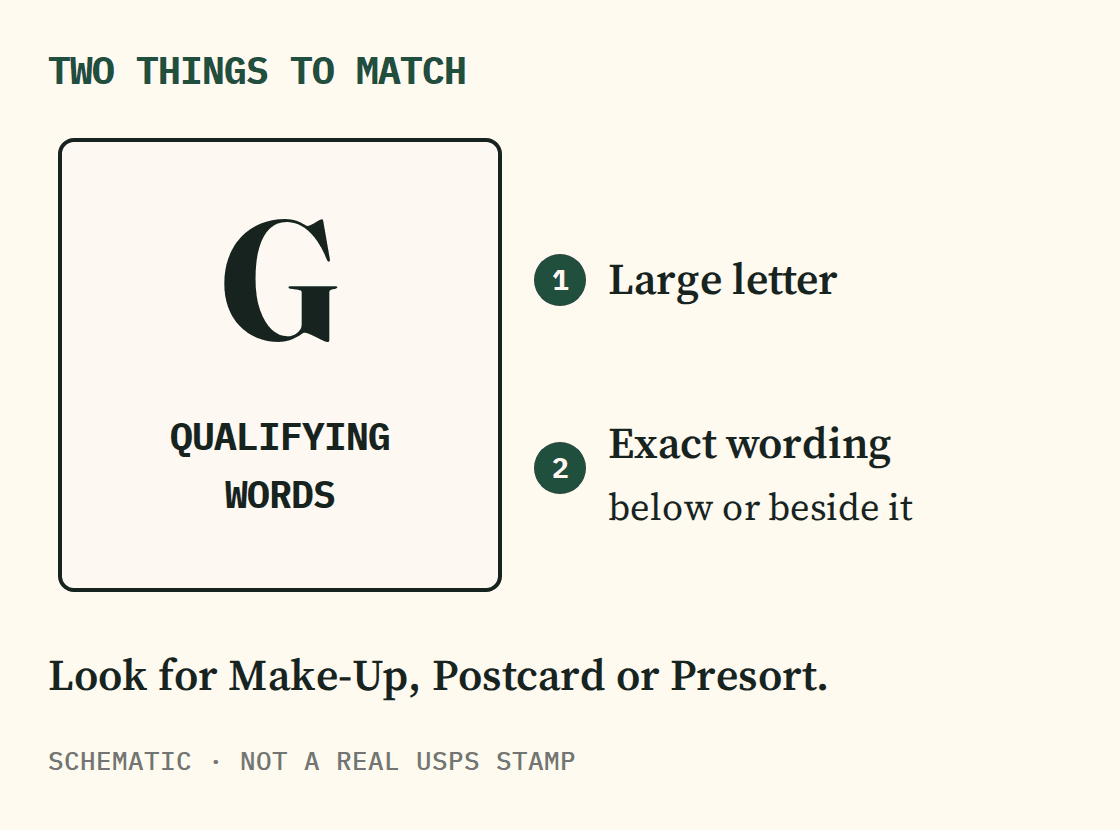
The drawing shows where to look; it cannot identify your stamp. Use USPS’s pictures of the actual issues (opens in new tab) to compare the design and all the wording. If you cannot make a confident match, take it to a Post Office before counting it as postage.
Check how much postage your letter needs#
Once you have identified an eligible unused stamp, add its fixed value to any other postage you plan to use. Then compare that total with the required postage for your letter’s weight, shape and service. Our cost-to-mail guide keeps the current prices together.
For example, a regular F stamp and an F makeup stamp contribute 33 cents together: 29 + 4. That is their combined contribution, not a claim that they cover a letter today. Add enough eligible postage to cover the difference.
USPS’s stamp-validity rule (opens in new tab) sets the original issue value for these fixed-value lettered and makeup stamps. This is why an old lettered stamp and a Forever stamp need different calculations.
When to check with USPS first#
A presort stamp needs more than a value lookup. USPS restricts precanceled postage to authorized permit holders. If yours says Presort or Presorted and you are mailing an ordinary personal letter, ask USPS before using it.
Also ask before using a damaged, defaced or questionable stamp. USPS excludes mutilated or defaced stamps and postage cut from stamped stationery. Previously used stamps are not spare postage for a new letter. The DMM stamp rules (opens in new tab) cover these restrictions; this table is not an authenticity check.
Charity or semipostal issues are another category. Do not assign them an A–H value because they lack a printed price. The old-stamp guide explains how to separate those from ordinary postage.
Before mailing, confirm three things: the exact issue, whether you may use it, and whether the total covers this letter. If the design or wording is still uncertain, bring the stamp and the letter to USPS together.