Key takeaways
- Stamps on the outer envelope show no effect in postal trials — a stamped reply envelope raises response odds by about a quarter (Cochrane, 2023).
- Hand-addressing is the strongest envelope evidence: OR 1.23 across nine trials — reserve it for the priority tier.
- First-Class Mail follows a moved owner for 12 months; unendorsed Marketing Mail is destroyed. Never let a one-to-one letter get downgraded.
- Use IMb delivery scans to call 2–3 days after the letter lands — timing the arrival, not the send.
- Paper has no open rate: judge campaigns by qualified owner conversations per hundred letters.
Joe Wechsler pulled every licensed home-care agency from state websites, kept the 24 that looked real, and mailed 24 letters. Four or five came back undelivered. The rest produced six phone calls, two offers, and the company he now owns (Acquiring Minds, 2026 (opens in new tab)).
Every part of that story happened on paper: the returned envelopes that flagged a decaying list, the letter that waited on a desk until an owner was ready to talk. None of it has an email equivalent — and almost none of it appears in the usual search fund direct mail personalization advice, which stops at list hygiene and a custom opening line.
This page is the paper half: 25 owner-letter tactics built on what paper can do that email can't, in five buckets — the address layer, the envelope, the letter as an object, the USPS infrastructure most senders never touch, and timing. They apply to any ETA direct mail campaign, traditional and self-funded searchers alike. Every number is attributed to a named source — and where the evidence is weak or negative, the tip says so instead of pretending.
The campaign guide owns the execution side — owner-file cleanup, proofing, and batch QA. If you are still choosing between paper and email, start with the channel comparison.
The 25 at a glance#
Bucket | Tactics |
|---|---|
A. The address layer (1–5) | USPS verification · NCOA · business vs. home · suite numbers · a return address you monitor |
B. The envelope (6–10) | sealed letter · the reply-envelope stamp · hand-addressing · envelope size · ink color |
C. The letter as an object (11–15) | one page · paper stock · wet-ink signature · restrained letterhead · one enclosure |
D. USPS infrastructure (16–20) | barcode tracking · Informed Delivery · the tracked touch · endorsements · First-Class, not Marketing Mail |
E. Timing and follow-through (21–25) | time the arrival · a letter that can sit · two readers · follow-up continuity · measure conversations |
Layer 0: get the personalization right first#
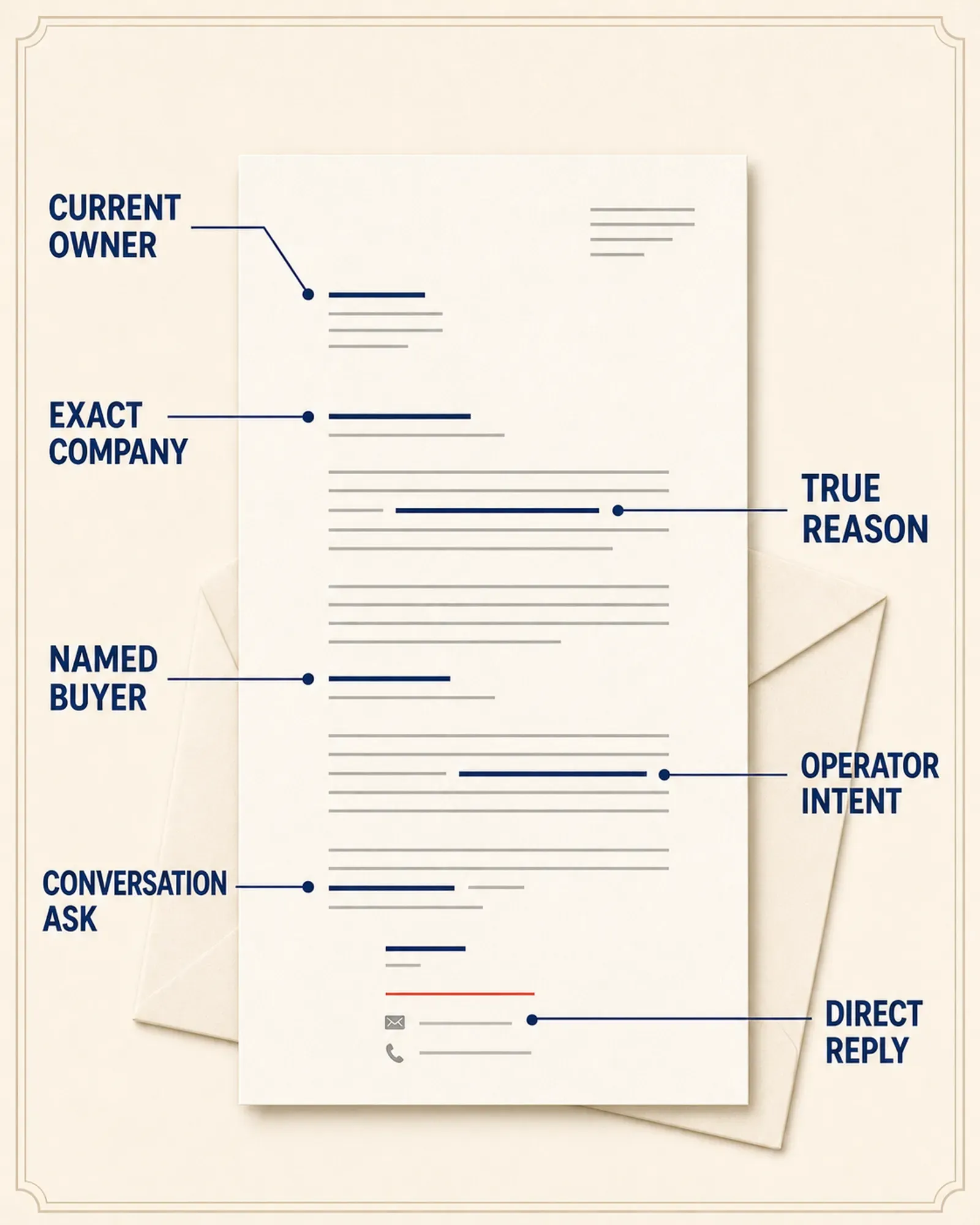
None of the 25 tactics below can rescue an owner letter that fails here. The full personalization checklist was version one of this page; it compresses to six moves.
- Verify the owner and title against the company site, the state entity record, and one current source — a database row proves someone was associated with a company, not that they still own it.
- Use the exact company name the business uses today.
- Confirm it is still operating.
- Select each company for a thesis-driven reason you can say out loud, not because it appeared in an export.
- Write as the named human who will take the call, and say plainly that you intend to acquire and operate one company.
- Ask for a conversation, not a sale decision.
One personalized, publicly verifiable observation is enough — and it needs a paper trail.
Merge preflight
Before any custom line enters a letter, save four fields: the source URL, the exact supported phrase, the verification date, and the proposed sentence. Then apply the face-to-face gate: if you would not say the sentence across a desk, it does not go in the letter.
Helpful vs. creepy
Helpful — “Your public services page says municipal pump maintenance is a core service. That fits the operating work I am looking for.” Creepy — “I noticed you live near Lakeview Park and that your daughter recently joined the company.” The first explains business fit from a public company source; the second uses personal details the acquisition thesis does not need. Delete it.
Every tactic below carries one of three execution modes:
Execution mode | Human control |
|---|---|
Manual | Research or finish each priority letter individually |
Template-compatible | Validate the source data and rendered output before sending |
Segment-level | Confirm the rule is true for every recipient in the wave |
How to read the numbers here
The trial evidence in this post comes from adjacent domains, and we label it that way. The odds ratios are from the Cochrane review of postal questionnaire trials (Edwards et al., 2023 update) — surveys, not acquisition letters. Attention figures come from JICMAIL, a UK panel measuring how businesses handle mail. We think the mechanics transfer — an envelope gets opened or it doesn’t — but the response baselines do not, and practitioner stories are a sample of one. No number here is unattributed, and several tips report evidence against popular tactics.
The address layer: what an email bounce can't tell you (1–5)#
An email bounce is binary and instant. An owner letter fails slower — but it fails with more information, and USPS gives you tools to repair the list before and after you mail.
1. Verify every address against USPS data before you merge#
Execution: Template-compatible.
Run every address through USPS-backed verification — CASS standardization with the ZIP+4 code — before the merge, not after the returns come back. Bad addresses cluster in scraped and stale lists, and each one costs a printed letter, postage, and two weeks of silence.
This is one place tooling does the work: Postmarkr verifies every address against USPS data before printing. For the full owner-file cleanup workflow, use the campaign guide.
2. Run the list through NCOA — owners move, your data doesn't#
Execution: Template-compatible.
NCOALink is USPS's change-of-address dataset: roughly 160 million permanent change-of-address records filed by individuals, families, and businesses, with full-service processing covering moves filed in the last 48 months (USPS PostalPro (opens in new tab)). About 12% of Americans move in a year (U.S. Census Bureau). A list scraped 18 months ago preserves addresses as they were, not as they are.
USPS takes this seriously enough to mandate it: mailers claiming commercial First-Class or Marketing Mail prices must have updated their lists within 95 days of the mail date under the Move Update standard (PostalPro (opens in new tab)). Treat the compliance rule as a hygiene tip: an NCOA pass before each wave catches the owner who now runs the company from a new address.
3. Business or home address is a deliberate choice, not a data field#
Execution: Segment-level.
Default to the business address: a business letter about the business, arriving at the business. Home mail can break through — it can also read as surveillance. The SearchFunder home-address discussion (opens in new tab) holds both views: one owner said home delivery could cut through, and also felt a line had been crossed.
Use a home address only after human review and with a legitimate reason — never just because a data broker sold you one.
4. Watch the suite and unit numbers#
Execution: Template-compatible.
We could not find a citable USPS figure for how much B2B mail dies for want of a suite number, so treat this as operational guidance, not statistics: in a multi-tenant building, a letter without its secondary line depends on whoever sorts the lobby mail. Address verification (tip 1) can flag records missing a required unit number — fix them before the merge, or move that owner to the priority tier for individual research.
5. Use a return address you monitor#
Execution: Segment-level.
A returned envelope is mail's error message, and it says more than an email bounce ever will: moved, refused, no such number, forward expired. That only works if returns reach a mailbox someone actually checks, and every return gets logged against the CRM record before the next wave.
Wechsler's 24-letter campaign came off an official state licensing list — about as current as small-business data gets — and still: "I think four or five of them got returned to sender. But I had six phone calls, two offers and one closing out of just that one letter" (Acquiring Minds, 2026 (opens in new tab)). The returns weren't failure. They were the list telling him exactly where it was wrong.
The envelope: the only part of a search fund letter with trial evidence (6–10)#
First, the counterweight. Andrew Kurzrok wrote what he calls beautiful letters — hand-signed, mailed in Priority Mail envelopes — to over 15 owners and got "0, 0 feedback" (Acquiring Minds, 2026 (opens in new tab)). He bought a company he found by cold-calling instead. Presentation cannot rescue a weak reason to write; the reason lives in Layer 0.
What presentation decides is whether a good letter gets opened first, last, or never — and it is the one part of outreach with randomized trials behind it.
Envelope choices to review: a monitored return address; an ancillary-service endorsement appropriate to the mail class and handling you need; postage format; recipient-address presentation; available barcode scan information; and an optional reply envelope. Check the applicable postal rules before adding an endorsement. Scans can support an arrival estimate, but cannot establish physical receipt. These presentation choices do not guarantee a response.
6. Sealed letter, never a postcard, for succession mail#
Execution: Segment-level.
An acquisition approach can raise questions before the owner wants employees or advisors involved. A sealed envelope keeps the message between you and the owner; a postcard shows it to everyone who handles the mail. Address it to the owner at the business (tip 3). Do not put a succession message where front-desk staff reads it before the owner does.
7. Put the stamp where the evidence is: the reply envelope#
Execution: Manual.
Do real stamps improve direct mail response rates? Not on the outside of the envelope. Searcher lore says a real stamp there signals a human sender; the trials say otherwise.
Lore: "No franking if possible." — a searcher whose mail campaigns produced two acquisitions (SearchFunder (opens in new tab)) Trials: Stamps on outgoing envelopes showed no effect on response (OR 0.95, 95% CI 0.88 to 1.03). Where stamps did work: stamped return envelopes beat franked ones, raising response odds by about a quarter (OR 1.23, 95% CI 1.13 to 1.33) — though commemorative stamps added nothing over standard ones even there (OR 0.92) (Cochrane, 2023 (opens in new tab)).
So spend the effort inside the envelope: enclose a small stamped, addressed reply envelope or card as a third response path beside phone and email. Some owners will never call a stranger but will mail back a note. And if your letters go out with printed postage — Postmarkr's do — the evidence says the metered look on the outside is costing you nothing.
8. Hand-address the priority tier#
Execution: Manual.
The same Cochrane review pooled nine trials (6,030 participants) of handwritten address labels against computer-printed ones: response odds up by a quarter (OR 1.23, 95% CI 1.09 to 1.37). That is the strongest envelope-level evidence there is, and it costs only time.
Time is the constraint, so tier honestly: hand-address the 20–30 owners your thesis cares most about, and let the scaled batch go out printed. Machine-pen addressing exists and practitioners disclose using it — but printed-pretending-to-be-handwritten is a false claim on an envelope, and nothing Postmarkr prints pretends to be handwritten. If handwriting matters, write by hand.
9. Pick the envelope size deliberately#
Execution: Segment-level.
A standard #10 envelope reads as correspondence. Oversized reads as marketing — and carries no evidence premium: in the Cochrane pool, larger envelopes showed no response effect (OR 0.93, 95% CI 0.74 to 1.17). You might still choose a bigger envelope so a priority-tier letter arrives flat and unfolded; just know you are buying presentation, not response odds, and giving up the correspondence read to get it.
10. Ink color is your cheapest honest A/B test#
Execution: Segment-level.
Here is the full evidence picture — all of it. One randomized trial of 2,524 recipients found green ink lifted response from 61.4% to 65.7% against black (Taylor et al., Journal of Clinical Epidemiology, 2006 (opens in new tab)). But the Cochrane pooled estimate for colored ink could not confirm an effect (OR 1.16, 95% CI 0.95 to 1.42), and envelope color has never shown one in a trial — the brown-envelope estimate also crossed 1. Community lore likes colored envelopes anyway (SearchFunder tools thread (opens in new tab)).
Translation: unproven, harmless, and cheap to test. Split one wave, count qualified conversations per arm (tip 25), and you will hold better data for your niche than any study on this page.
The owner letter as an object (11–15)#
Scott Duncan mailed semi-customized letters daily — "on nice paper and big envelopes with an official looking logo" — and it "didn't yield very much in the way of results" (Acquiring Minds, 2025 (opens in new tab)). The object matters less than the lore says. It still matters more than email, because an owner letter is the only outreach artifact a recipient physically holds.
11. One readable page#
Execution: Template-compatible.
One page forces an owner letter to earn its place: who you are, why this company, what you intend, how to reply — visible without hunting. If it runs long, cut transaction mechanics, investor detail, broad criteria, and extra biography before shrinking the type.
12. Paper stock is a care signal, not a psychology hack#
Execution: Segment-level.
You will read that heavier paper makes letters feel more important. That research has not held up: a purely confirmatory replication of the classic weight-importance experiment found no effect (Beek et al., 2017 (opens in new tab)), and a meta-analysis found the published weight-importance literature shows signs of publication bias (Rabelo et al., PLOS ONE, 2015 (opens in new tab)). Duncan's nice-paper campaign above is the practitioner version of the same lesson.
So choose decent stock for the same reason you proofread: visible care. Expect nothing from it but the absence of cheapness.
13. Sign the priority batch in wet ink — and know what the data says#
Execution: Manual.
The signature trial — and our conflict
A randomized trial of 3,799 mailed questionnaires compared hand-signed cover letters against computer-printed signatures: 79.1% versus 78.4% response — no significant difference (BMC Health Services Research, 2005). Full disclosure: Postmarkr prints letters, so we profit if you conclude printing is fine. We are showing you the null result anyway.
Sign the priority tier anyway — and not only for sincerity. Pooled across 14 trials (15,006 participants), the same Cochrane review finds cover letters with a handwritten signature beat typed, scanned, or printed ones by about a quarter (OR 1.24, 95% CI 1.08 to 1.41). The null trial (opens in new tab) above is real; so is the pool that leans toward the pen — against our own printing interest, and we are telling you that too. The signature also marks the owners you committed real attention to, and practitioners agree ("A wet-ink signature goes a long way" — SearchFunder (opens in new tab)). Never describe a printed signature as hand-signed; the tactic is honesty, not theater.
14. Restrained letterhead; a photo only if it is authentically you#
Execution: Segment-level.
Name, simple mark, return address, clear typography — considered, not brochure-designed. Tato Corcoran's typed, mail-merged letter included a photo and a low-pressure ask, and it worked because it matched her (Acquiring Minds (opens in new tab)). A photo helps when it shows the real person who will take the call. Skip stock poses and manufactured intimacy.
15. At most one enclosure — and the best one is postage#
Execution: Manual.
One relevant enclosure can make a priority letter memorable: a trade article that proves you know the industry, or the stamped reply envelope from tip 7 — the only enclosure with trial evidence behind it. More than one insert reads as a campaign stunt and creates mailing problems. A trinket beats nothing on memorability and loses on seriousness; skip it.
The USPS infrastructure most senders never use (16–20)#
Every commercial letter in the U.S. — your owner letters included — rides a barcode layer, sorted, scanned, and time-stamped through every facility it passes. Most senders never look at any of it. These five tactics are pure physical-mail capability: each one either tells you something or heals your list, and none has an email equivalent.
16. Barcode scans help estimate arrival#
Execution: Template-compatible.
An Intelligent Mail barcode can provide mailstream visibility for eligible barcoded letters through USPS Informed Visibility (USPS PostalPro (opens in new tab)). Its information includes actual scans and assumed or logical handling events. Use it as an arrival estimate, not confirmation of physical delivery or receipt. Ordinary retail First-Class letters do not include the USPS Tracking service.
That scan trail is what makes bucket E work: you stop guessing when to call, because you know when the letter arrived. Every Postmarkr order includes this tracking automatically.
17. Informed Delivery: your envelope, in their inbox, free#
Execution: Segment-level.
USPS emails enrolled users a morning digest showing grayscale images of the address side of letter-size mail arriving that day (USPS (opens in new tab)). Your envelope gets a second, digital impression — one more reason the bucket B decisions carry weight, because the scan shows the address side, hand-addressing and all.
The honest caveat is enrollment, not eligibility. Residential, business, and PO Box addresses in eligible ZIP Codes can enroll — a business address requires a USPS.com business account — but your letter only appears for owners who signed up, and you cannot see or influence who has. Treat it as free upside on every letter, never as a channel you plan on.
18. Save the tracked, signature touch for late in the sequence#
Execution: Manual.
In the Cochrane pool, recorded delivery — the UK's signature-on-delivery service — raised response odds by more than half (OR 1.68, 95% CI 1.36 to 2.08) — the strongest effect of any envelope or delivery treatment in the review. The closest U.S. equivalent for a letter is Certified Mail.
But a certified letter from a stranger reads like a lawsuit. Use the heavyweight touch only after earlier letters and calls have established who you are — at a moment when "this one is important" lands as intent, not threat. Do not make it the first touch. Postmarkr sends tracked First-Class letters only and doesn't send Certified Mail. When your sequence calls for Certified Mail, mail that letter at a Post Office counter; the certified guide covers the USPS service itself.
19. Endorsements make the list heal itself#
Execution: Template-compatible.
Print "Address Service Requested" on the envelope and USPS changes what happens when an owner has moved. For First-Class Mail in months 1–12 after the move, your piece is forwarded and a separate notice of the new address comes back to you (for a correction fee). In months 13–18, the piece itself comes back with the new address attached (DMM 507, Exhibit 1.5.1 (opens in new tab)). Every wave you mail updates the file for the next one.
Pair it with tip 5's monitored return address and tip 2's NCOA pass, and the list gets more accurate each quarter — the opposite of what a scraped list does.
20. First-Class, not Marketing Mail, for one-to-one letters#
Execution: Segment-level.
Should owner letters go First-Class or USPS Marketing Mail? First-Class — because of what happens after a move. First-Class Mail follows a moved owner by default: forwarded at no charge for 12 months, then returned with the new address attached through month 18 (DMM 507 (opens in new tab)). Unendorsed USPS Marketing Mail gets neither. The Domestic Mail Manual's words: "Piece disposed of by USPS." Your letter to a moved owner is simply gone, and nothing tells you.
Marketing Mail's discount exists for exactly the kind of mail a succession letter must not resemble. Do not let a mail house quietly downgrade the class to save cents per piece. Postmarkr sends every letter First-Class.
Timing and follow-through: owner outreach on the channel that waits (21–25)#
Everything in buckets A through D happens before mailing. This bucket covers follow-up afterward: use available arrival estimates to plan your next contact, while keeping the uncertainty about physical receipt clear.
21. Time the arrival, not the send#
Execution: Template-compatible.
The mailing date alone does not tell you when an owner received the letter. Where scan information is available, use it to estimate arrival and choose a follow-up time that suits your outreach. A call a few days after estimated arrival is a planning example, not evidence that the letter reached the owner or was read. Mailing in waves can spread this follow-up work across your schedule.
Example follow-up plan: record the mailing date, use available scan information to estimate arrival, and choose a suitable time for a call or email afterward. These are planning choices. A scan or logical delivery event does not confirm physical receipt or that the owner has read your letter.
22. Write a letter that can sit#
Execution: Template-compatible.
Business mail in the JICMAIL panel (opens in new tab) is handled 4.8 times and lives 9.1 days per item (Q1 2026) — UK panel data, but the mechanic transfers: paper persists in a way no inbox item does. Searchers see the long tail directly:
"I have had various owners tell me my letter has been sitting on their desk for X amount of time and that looking at it has finally prompted them to pick up the phone and call me." — a searcher with two mail-sourced acquisitions (SearchFunder (opens in new tab))
So write for the letter's whole life, not its first read: no expiring urgency, no "this month only," an ask as answerable in March as it was in January. Persistence is the strategy.
23. Write for two readers#
Execution: Segment-level.
The same JICMAIL data says each business mail item reaches 1.16 people. Our reading of that number for owner outreach: assume an office manager or spouse may open and route the letter before the owner sees it. The envelope and first paragraph should survive a gatekeeper's skim — clear sender, legitimate purpose, nothing that embarrasses the owner in front of staff (tip 6).
24. Follow-up explicitly references the letter#
Execution: Template-compatible.
Store the letter version, mail date, and custom fact before follow-up, then open with them: "I sent a short note last week after seeing municipal pump maintenance on your services page." One conversation across two channels, not two campaigns. The searcher quoted above runs the same cadence — an email "a week or so after the physical letter has landed" (SearchFunder (opens in new tab)). Channel sequencing lives in the channel comparison.
25. Paper has no open rate — measure qualified conversations#
Execution: Segment-level.
Email seduces with dashboards; paper gives you nothing until the phone rings. That is a feature: it forces the only metric that matters. Count qualified owner conversations per hundred letters, by segment and letter version, in the CRM (the outreach tools guide covers the stack). Returns (tip 5), delivery scans (tip 16), and address notices (tip 19) are diagnostics. Conversations are the scoreboard.
The hierarchy has not changed: correct owner, true reason, credible sender, easy response, traceable follow-up. What paper adds to a search fund campaign is everything above — an address layer that heals itself, an envelope with real trial evidence, an object that persists for days, an infrastructure that reports back, and follow-up built on arrival instead of hope.
When the list and the letter are ready, send the batch — one letter or a hundred, First-Class, tracked, verified against USPS before printing.